The Astrophysics FFT Explorer: Turning Raw Sky Data into Discovery Infrastructure
The Astrophysics FFT Explorer: Turning Raw Sky Data into Discovery Infrastructure
Introduction — The Data Problem in Modern Astronomy
Astronomy has entered a regime where data accumulation has dramatically outpaced human interpretation.
Large sky surveys now generate observational datasets measured in petabytes. The Vera C. Rubin Observatory’s Legacy Survey of Space and Time (LSST), for example, is expected to produce roughly 20 terabytes of raw data every night, ultimately accumulating tens of petabytes of imagery during its operational lifetime.^[1]
The Sloan Digital Sky Survey similarly transformed astronomy by creating one of the largest digital maps of the sky, containing millions of celestial objects and terabytes of photometric and spectral measurements.^[2]
These datasets represent an extraordinary expansion in humanity’s observational capability. But they also expose a structural bottleneck: discovery still depends heavily on human-directed analysis.
Even with machine-learning pipelines classifying galaxies or detecting exoplanets, much of the sky remains computationally under-explored.
In practical terms, astronomy now has far more signal than it has interpretation capacity.
Signals Rather Than Images
Astronomical imagery is typically treated visually. Scientists inspect telescope images, algorithms classify visible structures, and catalogs are built from pixel-level analysis.
But the universe does not fundamentally present itself as images.
It presents itself as signals.
Every astronomical image is a spatial brightness distribution. From a signal-processing perspective, that distribution can be decomposed into frequency components using Fourier transforms.
Transforming image data into spectral space reveals structural patterns that are difficult to detect directly in pixel space.
Regular stellar distributions, rotating galaxies, diffuse gas clouds, and periodic signal structures each generate distinctive frequency signatures when transformed.
This is why Fourier transforms have long been used in astronomical image reconstruction, interferometry, and noise filtering.^[3]
The key insight is simple:
If celestial structures produce distinct frequency signatures, then those signatures can be compared, cataloged, and learned.
The Case for FFT-Centered AI Training
Most machine-learning systems in astronomy are trained directly on images.
This approach works well for classification tasks such as galaxy morphology detection or exoplanet transit identification.
But training AI systems on Fourier-transformed representations introduces a different capability: structural comparison across large datasets.
Rather than asking:
“Does this image look like a spiral galaxy?”
A spectral model can ask:
“Does this signal resemble the known frequency signature of a rotating stellar system?”
This shift changes the role of AI from a classifier to a signal interpreter.
Spectral-space comparison enables detection of anomalies that may not resemble known visual structures but nonetheless contain recognizable signal patterns.
This becomes especially powerful when combined with continuous streams of telescope imagery.
An AI trained on astronomical FFT datasets could continuously process incoming observations and compare their spectral signatures against a global library of known celestial structures.
Instead of static catalogs, astronomy gains a dynamic discovery pipeline.
The Astrophysics FFT Explorer
The Astrophysics FFT Explorer is an interface designed around this idea.
Rather than browsing astronomical images, users interact with a continuously updated spectral discovery system.
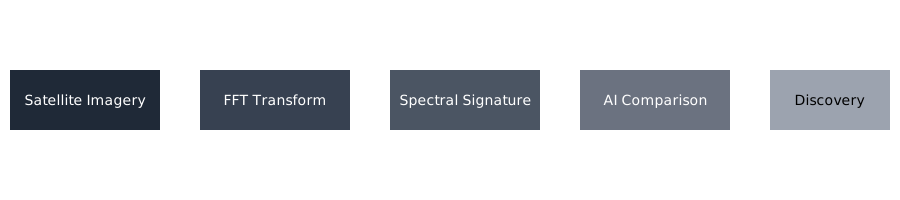
The system continuously processes observational imagery into FFT signatures.
Those signatures are compared against known astronomical signal structures.
When the system detects a potential match or anomaly, it generates a candidate discovery.
The interface is therefore not simply a visualization tool.
It is a navigation system for scientific discovery.
Interactive Grid of Deep Space
Astronomical maps are typically navigated visually, using coordinates and catalog overlays.
The FFT Explorer instead presents the sky as a knowledge-density grid.
The observable sky is divided into standardized spatial cells. Each cell represents a region defined by angular coordinates and observation coverage.
Cells encode three pieces of information simultaneously:
• observational brightness data
• degree of scientific study
• presence of known celestial structures
Regions with extensive analysis appear bright and well-defined. Regions with little study appear faded, signaling discovery opportunity.
Hovering over a grid cell reveals a metadata panel including:
section name
percent of region studied
key known structures
satellites collecting data
Clicking a cell expands the region into a full-screen exploration mode.
Case Study — AI Discovery in Existing Sky Surveys
Automated discovery is already reshaping astronomy.
Machine learning systems analyzing Kepler telescope data have successfully identified previously undetected exoplanets by detecting subtle signal patterns within stellar brightness curves.^[4]
Similarly, galaxy classification projects such as Galaxy Zoo initially relied on citizen scientists to classify structures in telescope imagery. More recent approaches have replaced large portions of that work with neural networks trained to recognize galaxy morphology automatically.^[5]
These systems demonstrate that discovery pipelines increasingly depend on computational interpretation rather than manual observation.
However, most current pipelines still operate within narrow classification frameworks.
The FFT Explorer proposes a broader model: a discovery system that continuously compares spectral signatures across the entire sky.
Contour Maps of Astronomical Knowledge
Once a user selects a sky cell, the interface transitions to a contour map.
Contours separate three zones:
studied regions
partially studied regions
unexplored signal regions
The boundaries emerge from observational density and catalog coverage.
This visualization helps scientists focus exploration where discovery probability is highest.
Unstudied signal regions appear as darker pockets inside the contour map.
Clicking any of these regions launches an AI spectral sweep.
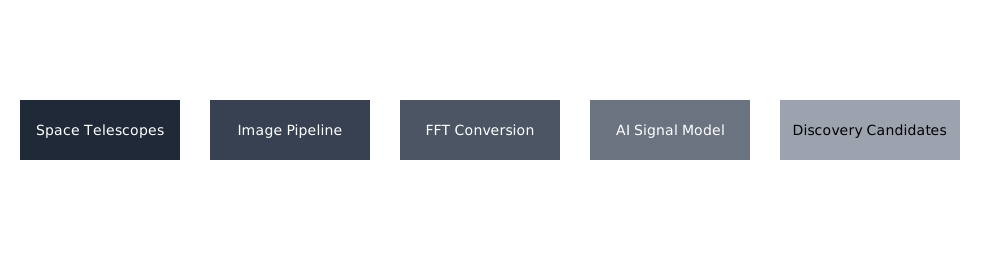
AI Spectral Sweep
When a contour region is selected, the FFT Explorer launches an automated spectral sweep.
The sweep converts all available imagery for the selected region into Fourier representations and compares those signatures against a reference library of known astronomical structures.
Two analysis streams appear simultaneously within the interface.
The first stream is semantic interpretation.
This layer translates spectral matches into human-readable observations.
Examples might include:
Possible planetary body detected
Cometary structure with extended tail
Star with solar-type spectral characteristics
Rotational signal consistent with stellar cluster
These interpretations are not definitive conclusions. They are structured hypotheses derived from signal similarity.
The second stream is raw spectral analysis.
Here the system displays the FFT output and signal correlations that produced the semantic inference. This stream allows researchers to audit the reasoning process behind each candidate discovery.
Together, the two streams create a hybrid interface: human-readable interpretation backed by raw signal evidence.
Confidence Scoring and Scientific Review
Once the spectral sweep completes, the system generates a structured summary.
Each candidate discovery is assigned a probabilistic confidence score derived from multiple signal comparisons.
Example output:
Possible planetary body — 82% confidence
Cometary structure — 64% confidence
Solar-type star — 91% confidence
Confidence scores are color-coded:
green: high probability
yellow: moderate probability
red: low probability
High-confidence results can be submitted directly to a scientific review channel.
The submission package includes:
source telescope imagery
FFT signatures used in detection
AI reasoning summary
confidence estimates
cross-references to known astronomical catalogs
In this workflow the AI does not replace scientific review. It acts as a discovery accelerator, generating candidate findings that can then be validated by researchers.
Discovery Infrastructure Rather Than Discovery Events
Astronomy has historically progressed through isolated discoveries.
A telescope detects an anomaly.
Researchers analyze the observation.
A paper follows.
But large-scale surveys and computational analysis are gradually shifting the discipline toward continuous discovery systems.
The FFT Explorer represents an extreme version of this shift.
Instead of waiting for discoveries to emerge from individual datasets, the system continuously evaluates the sky as a dynamic signal field.
Every observation becomes part of an ongoing search process.
Discovery becomes less like a rare event and more like a persistent computational activity.
Example — From Telescope Image to Spectral Signature
To understand how the FFT Explorer operates in practice, consider a typical astronomical dataset.
A telescope image is fundamentally a brightness field. Each pixel represents photon intensity from a specific direction in the sky.
When the image is converted into Fourier space, the brightness distribution becomes a frequency map.
Large smooth structures—such as gas clouds—produce strong low-frequency components.
Highly structured objects—such as spiral galaxies—produce repeating frequency patterns corresponding to their rotating arms.
This transformation allows different celestial objects to occupy recognizable regions within spectral space.
A rotating galaxy cluster, for example, produces a distinct pattern of frequency harmonics that differ from the spectral structure generated by a comet tail or planetary transit.
By cataloging these spectral signatures, an AI system can compare new observations against known signal families rather than simply matching visual shapes.
This shift allows the system to identify patterns even when the original imagery is noisy, partially occluded, or visually ambiguous.
Spectral Libraries and Signal Comparison
The FFT Explorer assumes the existence of a large astronomical spectral library.
This library stores the Fourier signatures of known structures, including:
stellar systems
planetary transits
comet trajectories
nebula distributions
galaxy morphologies
Each entry contains both the raw FFT signature and metadata describing the observed object.
When the AI spectral sweep analyzes a new sky region, it compares incoming signatures against this library.
Two outcomes are possible.
The signal resembles a known spectral structure.
In this case, the system assigns a classification probability.
Or the signal diverges from known patterns.
In this case the system flags an anomaly candidate.
Because the comparison occurs in spectral space rather than visual space, the system can detect structural similarities even when the original imagery differs substantially.
Confidence Heatmaps
Within the FFT Explorer interface, discovery probability is visualized as a confidence heatmap.
Instead of simply marking regions as studied or unstudied, the system estimates the likelihood that additional analysis will produce new discoveries.
Regions with high anomaly probability appear in brighter colors.
Regions dominated by well-understood signal structures appear dimmer.
The heatmap is derived from three components:
observational density
spectral diversity
distance from known signal clusters
Areas with sparse observations but high spectral complexity become prime targets for exploration.
In effect, the heatmap turns the sky into a probability landscape for discovery.
Continuous Discovery Systems
Historically, astronomical discovery depended on moments of observation.
A telescope captured an unexpected signal.
Researchers investigated it.
Eventually a new object or phenomenon was identified.
The FFT Explorer represents a different paradigm.
In this model the sky is continuously monitored by computational systems that evaluate incoming signals against global datasets.
Every new observation becomes part of an evolving signal field.
Discovery no longer waits for human inspection.
Instead it emerges from continuous comparison across massive datasets.
This transformation mirrors similar shifts in other sciences, where automated pipelines now generate hypotheses that researchers subsequently test and refine.
Conclusion
Astronomy has historically advanced by building larger instruments.
Bigger telescopes gathered more light.
Better detectors captured fainter objects.
Higher-resolution surveys revealed more of the sky.
But the fundamental challenge has now shifted.
Humanity already collects more astronomical data than scientists can realistically analyze.
The bottleneck is no longer observation.
It is interpretation.
The Astrophysics FFT Explorer proposes a different approach to that problem. Instead of relying on researchers to manually explore astronomical imagery, the system treats the sky as a continuous signal field and applies spectral comparison across massive observational datasets.
In this model, discovery becomes a computational process.
New celestial objects are not found only when someone inspects an image or runs a targeted analysis. They emerge from continuous comparison between incoming observations and the spectral library of known astronomical structures.
Human researchers remain essential.
But their role shifts from manually searching the sky to evaluating candidate discoveries generated by computational systems.
If astronomy enters this paradigm, the most powerful scientific instruments may not be telescopes alone.
They will be the interpretation systems that transform signals into knowledge.
Contextual Recommendation
Systems like the Astrophysics FFT Explorer illustrate a broader design challenge: how humans interact with large knowledge fields generated by AI.
As datasets grow beyond human-scale interpretation, the interface between discovery systems and human researchers becomes as important as the computational models themselves.
Exploring how interfaces shape scientific reasoning is a central focus of the Primary Design Co. development environment.
Readers interested in experimental interfaces for navigating complex knowledge systems can explore related prototypes here:
https://local.primarydesignco.com/
References
^[1]: Ivezić, Ž. et al. (2019). LSST: From Science Drivers to Reference Design and Anticipated Data Products. The Astrophysical Journal.
^[2]: York, D. et al. (2000). The Sloan Digital Sky Survey: Technical Summary. The Astronomical Journal.
^[3]: Bracewell, R. (2000). The Fourier Transform and Its Applications. McGraw-Hill.
^[4]: Shallue, C. & Vanderburg, A. (2018). Identifying Exoplanets with Deep Learning. The Astronomical Journal.
^[5]: Dieleman, S. et al. (2015). Rotation-invariant convolutional neural networks for galaxy morphology prediction. Monthly Notices of the Royal Astronomical Society.
^[6]: Ivezić, Ž. et al. (2021). Data Management for the Rubin Observatory LSST. Annual Review of Astronomy and Astrophysics.
[5] Dieleman, S. et al. (2015). Rotation-invariant convolutional neural networks for galaxy morphology prediction. Monthly Notices of the Royal Astronomical Society.