From Text to Symbols: A Semantic Memory Architecture for Conversational AI
Large conversational archives are difficult for both humans and machines to parse. The difficulty is not primarily scale but representation. Text is a sequential medium, while meaning is relational.
Modern digital work produces enormous quantities of conversational data: chat transcripts, design discussions, research notes, debugging sessions, and architectural debates. These conversations often contain the reasoning that produced the final artifact — the intellectual path that rarely survives in documentation.
Yet the infrastructure used to store this reasoning is crude. Most systems preserve conversations as chronological transcripts. Over time these transcripts grow into massive text files that are difficult to search and computationally expensive to process.
The result is a paradox: we record more thought than ever before, but we have little infrastructure for navigating it.
The Structural Failure of Text Archives
Human language unfolds sequentially. Sentences accumulate into paragraphs, arguments develop through time, and conversations record the order in which ideas appeared.
Sequential storage preserves chronology but obscures conceptual structure.
A large conversational archive might contain discussions about system architecture, solver experiments, patent drafting, design sketches, debugging sessions, and financial modeling — all interwoven into a single chronological stream.
Humans can sometimes navigate such archives using intuition and contextual memory. Machines cannot. Retrieval systems must repeatedly scan large volumes of text to locate relevant fragments.
The cost of retrieval therefore scales with archive size rather than conceptual relevance.
Information theory has long shown that efficient communication depends on representing recurring patterns symbolically rather than duplicating them repeatedly.^[1] Conversational archives contain enormous redundancy: common terms, recurring ideas, and shared references appear thousands of times across discussions.
When stored as raw text, this redundancy multiplies computational cost.
Chunking: The First Structural Boundary
The first step toward a more efficient representation is dividing large archives into bounded chunks.
Chunking introduces stable processing units that can be analyzed independently. Each chunk becomes a small region of the archive from which semantic structure can be extracted.
This provides several engineering advantages:
processing workloads become predictable
parallel token extraction becomes possible
reconstruction anchors are preserved
Chunking does not yet extract meaning. It simply creates the structural boundaries required for semantic analysis.
The next stage transforms each chunk into a symbolic representation of the ideas it contains.
Hierarchical Tokenization
Within each chunk, the system extracts concept tokens. These tokens represent meaningful semantic units rather than simple word fragments.
Examples in a technical conversation might include:
chunk processing
concept graph
symbol stream
compression ratio
reconstruction algorithm
Each token becomes a node in a concept database. When the same concept appears again in later chunks, the system references the existing token rather than creating a new one.
Over time the database becomes a stable vocabulary representing the semantic structure of the entire archive.
Symbol Binning
Concept tokens are grouped into symbolic bins. Each bin corresponds to a symbol identifier that represents a weighted distribution over related concepts.
Engineering constraints guide this mapping:
maximum 100 concept tokens per symbol
combined probability weight ≤ 1.00
symbol library size ≈ 1,500 entries
These limits yield a conceptual capacity of roughly 150,000 addressable ideas.
The limits are computational rather than mathematical. They reflect indexing cost and CPU constraints rather than theoretical boundaries.
Figure 1 illustrates the token-to-symbol mapping.
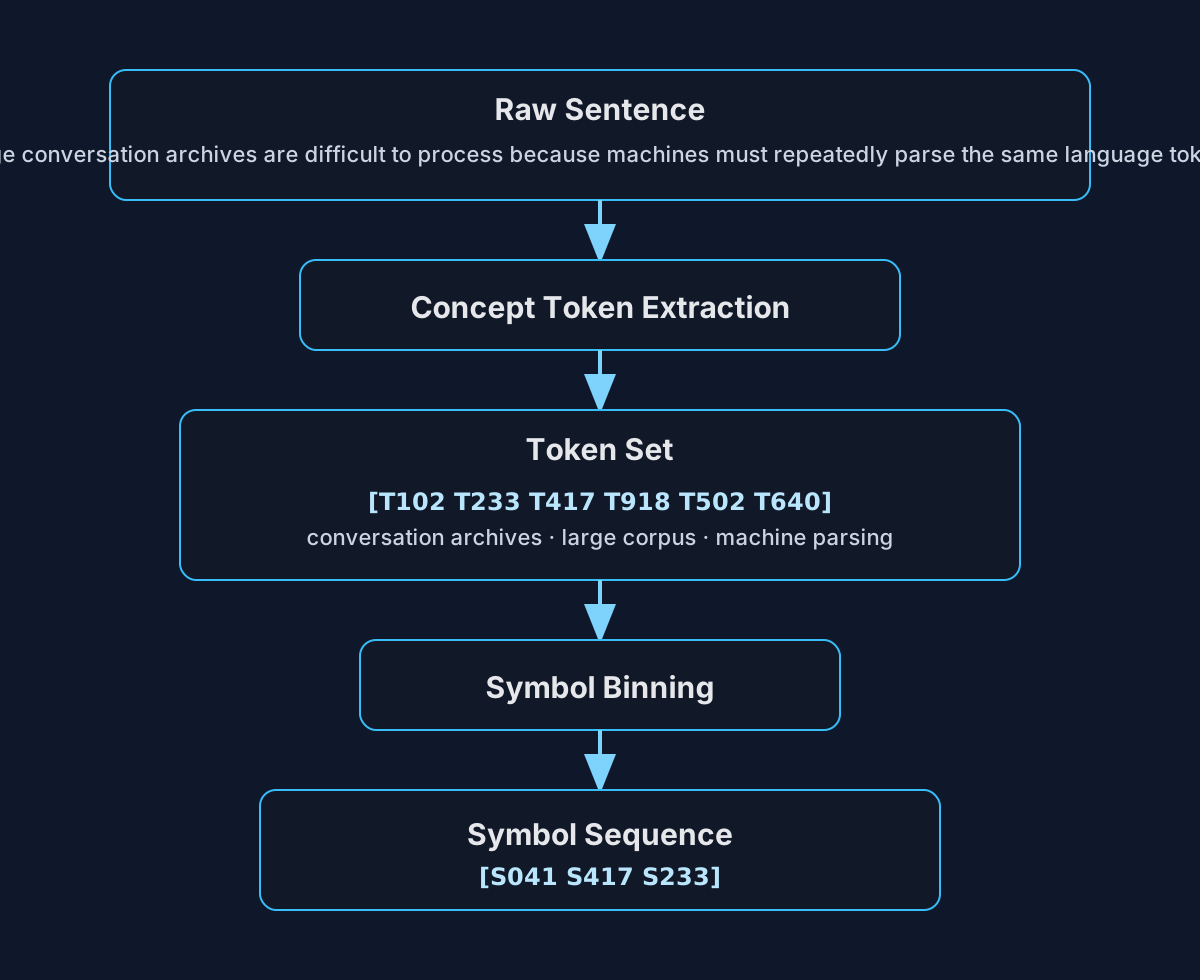
Alt text: A table showing concept tokens mapped to a single symbol identifier with probability weights that sum to one.
Concept Adjacency
Concept tokens rarely appear in isolation. Ideas tend to cluster within discussions.
The system therefore records adjacency relationships between tokens that appear within the same chunk or nearby sequences. Each relationship receives a weight proportional to its frequency.
Over time these relationships form a concept graph.
The graph captures which ideas tend to appear together and which conceptual regions of the archive are strongly connected.
This structure later enables efficient semantic retrieval.
Dependent Symbol Stream Shards
Once tokens are mapped into symbols, the original conversation is encoded as a symbol stream.
A stream might appear as:
S041 S417 S233 S118 S233 S041 S882
Each symbol references a bin of concept tokens stored in the concept database. The stream therefore contains the structure of the conversation without duplicating the language itself.
Because the stream depends on the concept database to be interpreted, it is referred to as a dependent symbol stream.
Streams are stored as shards corresponding to bounded segments of the original archive. Sharding preserves local ordering while allowing the archive to scale indefinitely.
Figure 2 illustrates the compression pipeline.
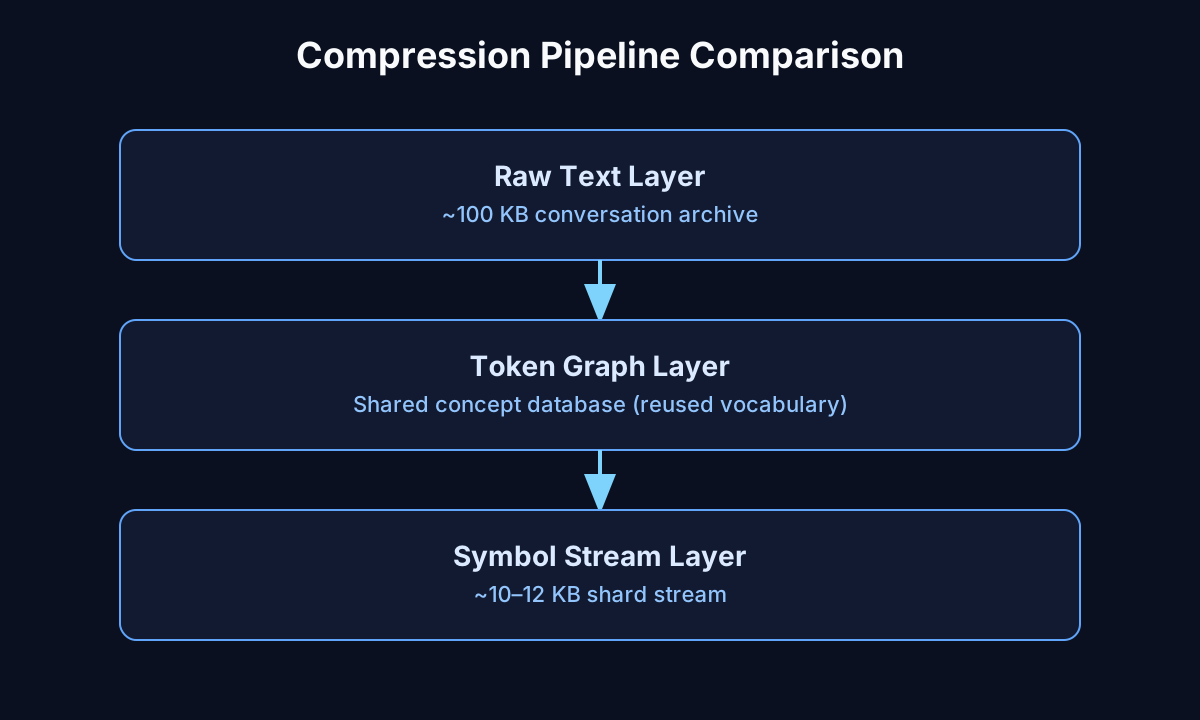
Alt text: Diagram showing raw text processed into chunks, tokens extracted, tokens grouped into symbols, and symbol streams stored as shards linked to a concept database.
Compression Characteristics
Symbolic encoding exploits the redundancy of language.
Concept tokens are stored once in the database and referenced repeatedly by symbol streams. Repeated phrases therefore collapse into compact identifiers.
Prototype experiments suggest that symbol streams often require eight to ten times less storage than the original text once the token database stabilizes.
Compression improves over time as the vocabulary of tokens becomes richer and more reusable.
Artifact Preservation
Conversational archives frequently contain structured artifacts:
code blocks
tables
research notes
configuration files
Flattening these artifacts into plain text destroys structural information.
The system instead stores artifacts as structured payloads attached to concept tokens. When symbol streams are reconstructed, these payloads are restored alongside the surrounding narrative context.
This ensures that conversational memory preserves both ideas and artifacts.
Semantic Memory for Agentic Systems
The primary purpose of this architecture is not compression but semantic memory for software agents.
When an agent queries the archive, the system performs four steps:
query tokenization
concept graph traversal
symbol shard retrieval
targeted reconstruction
Only the shards associated with relevant concepts are reconstructed.
The agent therefore receives a compact contextual window describing the ideas relevant to its query rather than a large collection of unrelated text fragments.
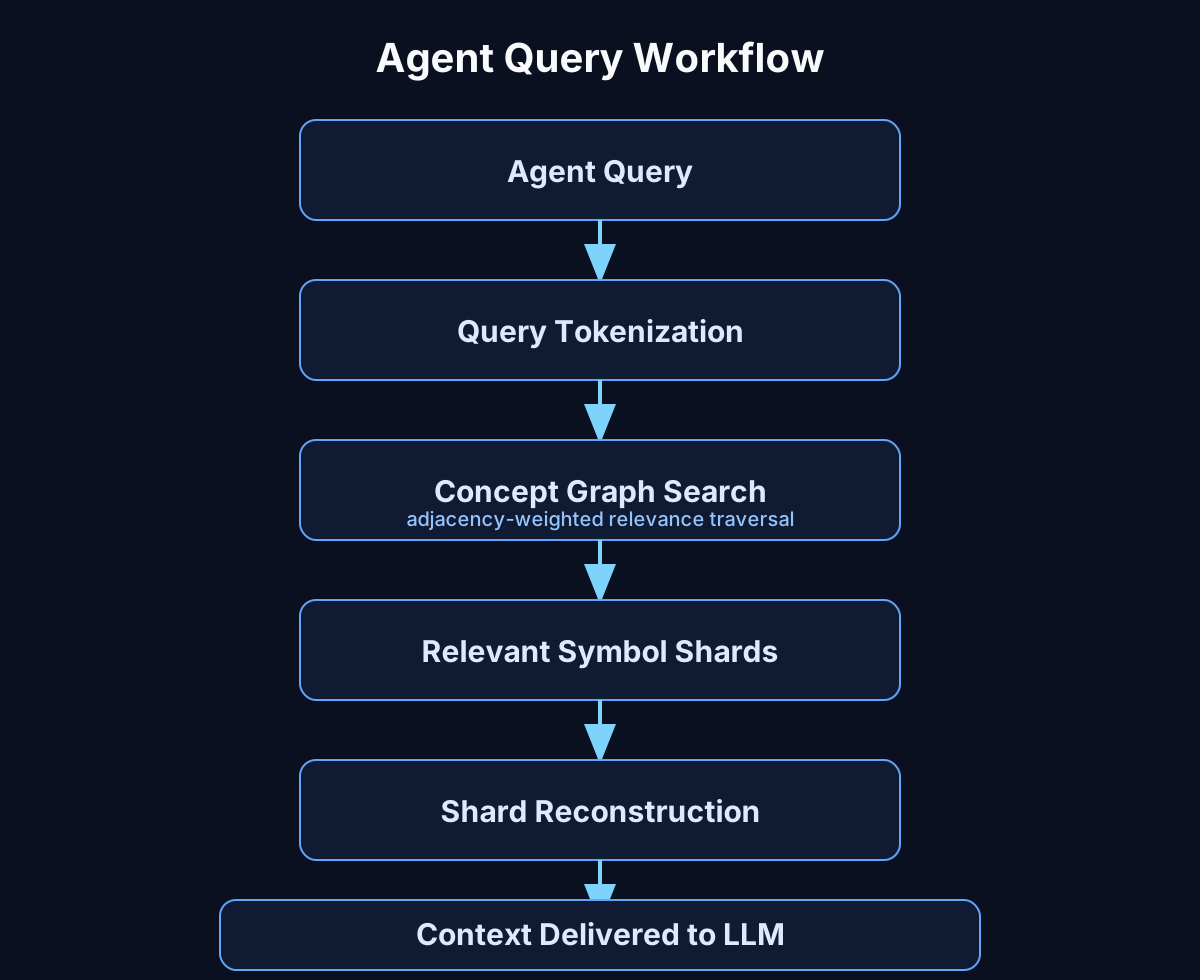
Alt text: Flow diagram showing an agent query transformed into query tokens, matched through concept graph search, linked to relevant symbol shards, reconstructed, and delivered as compact context to an LLM.
Reducing Computational Cost
Traditional retrieval systems return paragraphs or document fragments that must be parsed again by the language model.
Symbolic conversational memory shifts retrieval to the concept layer. The system navigates the concept graph first and reconstructs text only when necessary.
As a result, the amount of text delivered to the model scales with semantic relevance rather than document size.
Toward Semantic Operating Systems
Conversational archives are currently treated as historical transcripts. The symbolic architecture described here reorganizes them around meaning instead.
Concept tokens capture ideas.
Adjacency links capture relationships.
Symbol streams record conversational structure.
Text becomes a recoverable projection of a deeper semantic substrate.
Over time, systems built on this architecture could function as persistent memory layers for agentic software — knowledge stores that grow continuously as conversations accumulate while remaining computationally tractable.
Context
Primary Design Co. develops systems that transform unstructured information into navigable structures. The prototype discussed here demonstrates how conversational archives can be reorganized into concept graphs and symbolic memory streams.
Additional work exploring this direction can be found at:
https://local.primarydesignco.com
References
Shannon, C. E. (1948). A Mathematical Theory of Communication. Bell System Technical Journal.
Jurafsky, D., & Martin, J. H. (2023). Speech and Language Processing. Draft textbook.
Nelson, T. (1987). Literary Machines. Mindful Press.