The AI Project Round Table
The AI Project Round Table
Architecture Overview
The structure below formalizes the round table as a control plane with bounded specialist roles and threshold-triggered escalation.
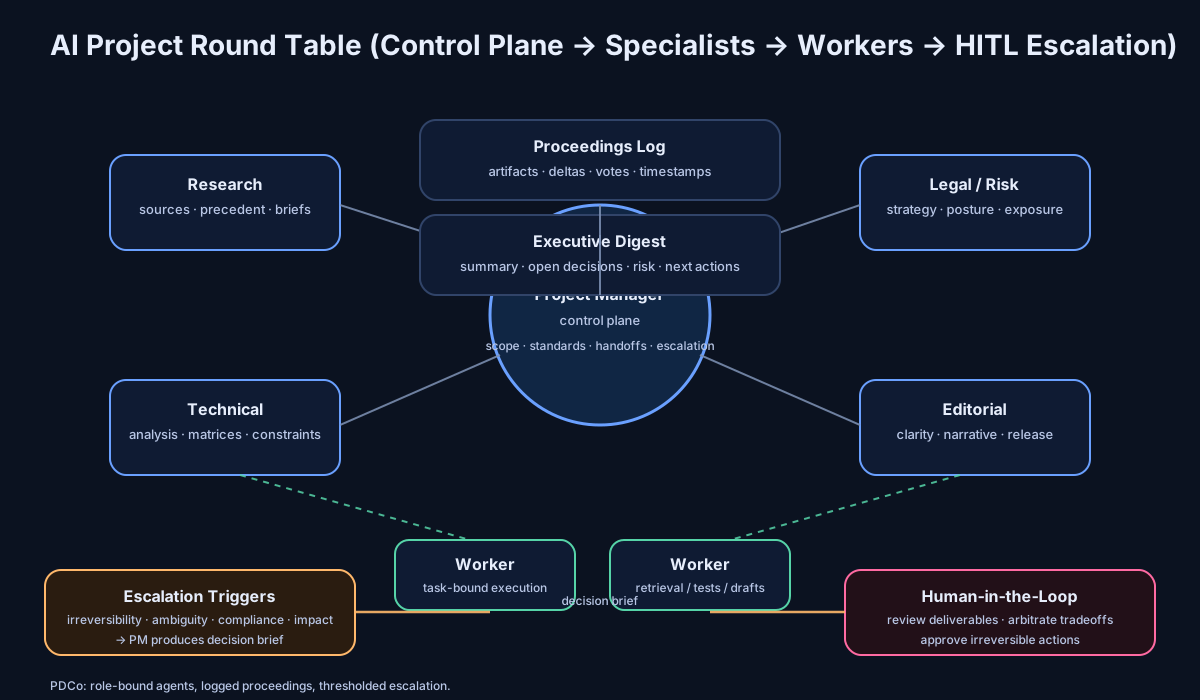
The interactive demo below models the separation between internal proceedings and executive digest. It simulates threshold-based escalation logic that routes decisions to the human-in-the-loop only when predefined governance criteria are exceeded.
Open the interactive Round Table demo
AI systems are routinely described as assistants or copilots. The metaphor is comfortable. It is also limiting.
In most deployments, the model is treated as a polymath: a single conversational entity expected to research, analyze, critique, draft, arbitrate, and finalize inside one uninterrupted transcript. It can handle small tasks, but it fails at institutional scale.
When responsibility is not partitioned, accountability dissolves. Decisions blur into prose, revision histories become opaque, and the human oscillates between delegation and micromanagement without structural support.
Organizational research demonstrates that role ambiguity and role conflict degrade performance and increase decision strain.^[1] When the “team” is one undifferentiated model, ambiguity is structural rather than incidental.
Human-in-the-loop (HITL) systems were designed to preserve supervisory authority over automation.^[2] Yet in most AI use, the human is placed in continuous validation mode rather than structured oversight. The result is either over-trust or over-control. Neither scales.
AI becomes strategically powerful only when structured as institutional architecture: role-bound agents, explicit authority, artifact standards, and thresholded escalation. The Project Manager functions as the control plane. Specialist agents operate within bounded mandates. The human intervenes only at defined leverage points.
This is institutional design, not prompt engineering.
I. The Failure of the Polymath Model
Treating a model as a polymath collapses three distinct functions into one stream:
- Knowledge retrieval
- Decision arbitration
- Artifact production
Herbert Simon’s theory of bounded rationality shows that decision environments must be structured to reduce complexity.^[3]
Supervisory control research shows that automation without clearly defined authority boundaries increases monitoring burden and reduces operator effectiveness.^[2]
Conversational interfaces blend reasoning, critique, execution logs, and final deliverables into one transcript, forcing the user to reconstruct workflow boundaries mentally.
This resembles running an organization inside a single email thread.
Consider a patent response to a §103 rejection. The task requires technical parsing, prior art comparison, legal framing, rhetorical calibration, and strategic risk assessment. In a single-model workflow, these domains merge, strategic concessions can disappear inside draft prose, and no escalation gate exists.
II. The Project Manager as Control Plane
Every disciplined AI system requires a right-hand agent: the Project Manager.
In distributed computing, the control plane defines policy while the data plane executes workload.^[4] The Project Manager plays the control-plane role.
Core responsibilities:
– Define subagent mandates
– Assign scope
– Enforce artifact standards
– Coordinate handoffs
– Monitor escalation triggers
– Produce executive summaries
High-reliability organization research emphasizes defined escalation channels under complexity.^[5]
Example charter:
agent:
  name: Project_Manager
  mandate: Orchestrate workflow, enforce artifact standards, manage escalation
  authority:
    can_spawn_agents: true
    can_modify_scope: true
    can_override_specialist: false
  escalation_triggers:
    - strategic_tradeoff_detected
    - unresolved_conflict_between_agents
    - legal_or_ethical_uncertainty
    - high-impact irreversible decision
  deliverables:
    - executive_summary
    - workflow_state_log
Without this layer, specialization collapses into blended narrative.
III. Designing Specialist Agents
Specialization follows necessity.
Role clarity research indicates defined expectations reduce coordination cost and improve task performance.^[1]
In a patent prosecution scenario:
Technical Analyst – Structural claim parsing – Prior art mapping – Architectural distinction analysis
Legal Strategist – Argument framing under §102/§103 – Risk evaluation – Amendment strategy
Research Agent – Case law retrieval – PTAB precedent surfacing – MPEP identification
Modular design reduces systemic fragility by decoupling components.^[6] Disagreement becomes visible rather than submerged.
IV. The Round Table Protocol
Specialization requires structured circulation.
Round Table protocol:
Domain artifact generation
Structured circulation
Recorded critique
Conflict logging
Consolidation or escalation
This mirrors deliberative institutional processes where structured disagreement precedes authority resolution.^[7]
Minor disputes consolidate internally. Irreversible strategic tradeoffs escalate.
V. Escalation Design
Escalation should be threshold-based.
Supervisory control literature distinguishes routine automation from supervisory intervention triggered by uncertainty or anomaly detection.^[2]
Escalation decisions can be formalized along two axes: ambiguity and irreversibility.
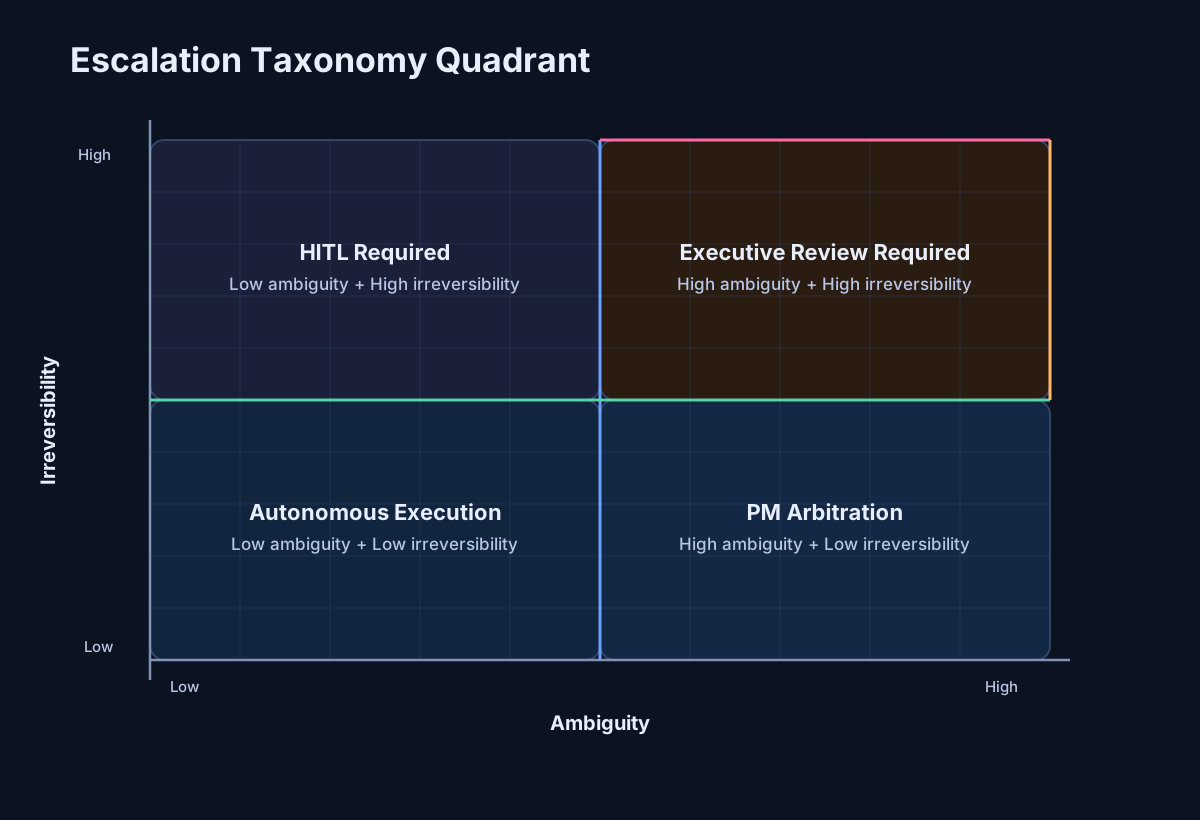
Escalation taxonomy:
Irreversibility Threshold – permanent scope alteration Ambiguity Threshold – conflicting high-confidence outputs Compliance Threshold – legal or institutional exposure Impact Threshold – material strategic consequence
When triggered, the Project Manager produces:
– Executive brief – Position summary – Recommendation path
The human intervenes at the policy level.
VI. Transparency Layers
Dual visibility strengthens trust.
Internal Proceedings Log – Full artifacts – Conflict records – Decision timestamps – Agent attribution
Executive Digest – High-level synthesis – Open decisions – Risk summary – Recommended action
Distributed cognition research shows cognition can be distributed across agents and artifacts.^[8]
VII. Institutional Consequences
When AI is structured as a round table:
– Accountability becomes legible – Disagreement becomes structured – Escalation becomes intentional – Reproducibility improves
The human shifts from operator to governor.
AI becomes institutional infrastructure.
Conclusion
The assistant metaphor constrains design.
The council metaphor expands it.
Design the Project Manager first. Define specialist mandates explicitly. Encode escalation thresholds. Separate proceedings from executive digest.
Then allow autonomous execution.
Human judgment enters precisely where leverage is highest.
References
^[1]: Rizzo, J. R., House, R. J., & Lirtzman, S. I. (1970). Role Conflict and Ambiguity in Complex Organizations. Administrative Science Quarterly, 15(2), 150–163.
^[2]: Sheridan, T. B., & Parasuraman, R. (2005). Human-Automation Interaction. Reviews of Human Factors and Ergonomics, 1(1), 89–129.
^[3]: Simon, H. A. (1957). Models of Man: Social and Rational. Wiley.
^[4]: Kreutz, D., et al. (2015). Software-Defined Networking: A Comprehensive Survey. Proceedings of the IEEE, 103(1), 14–76.
^[5]: Weick, K. E., & Sutcliffe, K. M. (2007). Managing the Unexpected. Jossey-Bass.
^[6]: Baldwin, C. Y., & Clark, K. B. (2000). Design Rules: The Power of Modularity. MIT Press.
^[7]: Habermas, J. (1996). Between Facts and Norms. MIT Press.
^[8]: Hutchins, E. (1995). Cognition in the Wild. MIT Press.