Determinism Is a Performance Feature
On paper, determinism reads like governance: audit logs, reproducible experiments, the kind of thing you add after the solver is “working.” In practice, determinism is a geometry you build into a system. Once you commit to deterministic aggregation, you stop being able to hide architecture behind luck. The system must behave the same way when run twice, and that requirement forces choices that reshape where time goes, where bandwidth goes, and which failure modes you’re allowed to tolerate.^[1]
The short version is this: determinism is not only a trust property. It is a performance property, because the constraints needed to guarantee reproducible hierarchy construction change the algorithmic pathways you can take, especially on accelerators and across distributed memory.
Deterministic aggregation produces three compounding advantages. First, the hierarchy is reproducible—the same partitioning emerges every time, independent of run ordering, scheduling, or hardware. Second, reproducibility forces predictable memory traffic: structures cannot vary by run, so memory footprints and communication surfaces stabilize and become tunable. Third, a well-specified deterministic construction is composable, defensible IP: it can be described as a protocol, dropped into multiple solver families, and distinguished as a system boundary rather than an algorithm. Each advantage reinforces the others, and all three follow from accepting determinism as a hard constraint rather than a preference.
The baseline most people hold in their heads for multilevel acceleration is an algebraic multigrid family tree: build a coarse representation from the fine operator, transfer residuals down, correct, prolongate back, and converge in far fewer Krylov iterations than the unpreconditioned solve.^[2] The details matter, because the “AMG-ness” lives in the details: which connections are considered strong, how coarsening is computed, how aggregates are formed, and how the prolongation operator is assembled.^[3]
That same detail layer is where determinism gets lost. Many practical coarsening and aggregation routines contain implicit nondeterminism. Sometimes it’s explicit—random seeds, randomized tie breaks, greedy matchings that depend on iteration order. More often it’s accidental: parallel reductions whose ordering changes, floating-point nonassociativity under dynamic scheduling, or race-dependent “first writer wins” updates. On a single machine this may look like noise; on a cluster it becomes divergence. Bitwise identity is hard precisely because the world is parallel.^[4]
If you’re trying to build a solver product, the cost of that divergence is not just scientific etiquette. It’s operational. You can’t reliably regress performance. You can’t reliably answer which parameter change caused which effect. You can’t reliably reconcile boundary aggregates across ranks unless reconciliation is itself a deterministic protocol rather than an emergent property of message timing. At scale, determinism is not a checkbox; it is infrastructure.
A deterministic transformed-field aggregation architecture takes a sharper position: the hierarchy is not “discovered” through iterative clustering or threshold-tuned strength-of-connection filtering. Instead, you map an embedding into a transformed coordinate space and then apply a deterministic partition rule that assigns every degree of freedom to an aggregate identifier in a way that is independent of stochastic initialization and independent of iterative coarsening updates.^[1] If ties occur, you resolve them by a fixed precedence rule; if the system is distributed, you reconcile boundary identifiers using deterministic keys and deterministic reduction ordering rather than whatever ordering the network happens to produce on that run.^[1]
This is not a claim that heuristic AMG is wrong. It’s a claim about what you are optimizing for. Heuristic coarsening is often designed to be sensitive to local physics proxies; deterministic transformed-field aggregation is designed to be stable under rerun, stable under partitioning, and stable under parallel execution. Those are different objective functions.
The key conceptual move is to treat “how you assign aggregates” as an operator-construction problem with a reproducibility invariant, not as a best-effort clustering problem. That move shifts effort upstream into the mapping and the deterministic partition. It also shifts effort downstream into how transfer operators and reduced operators are formed and applied.
Here is the high-level shape of that pipeline in diagram form, with the determinism boundary made explicit:
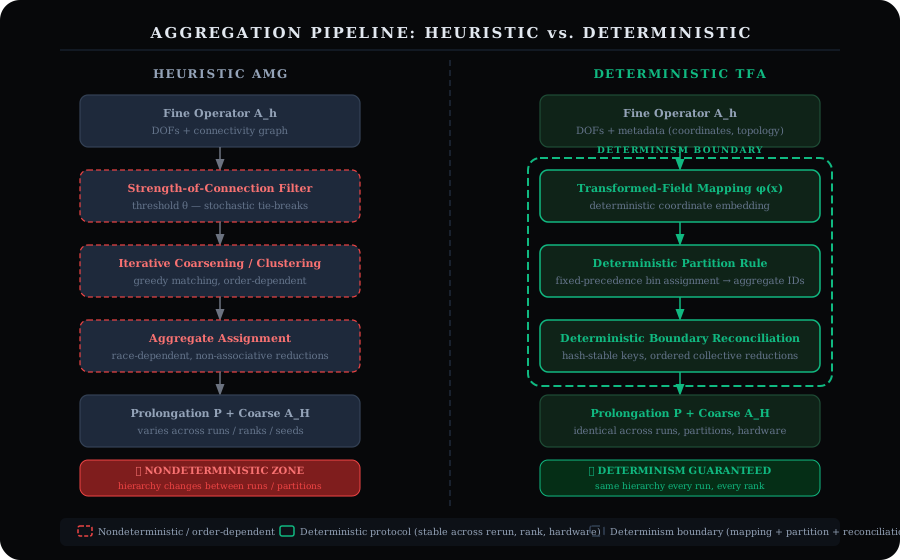
Once you take that position, the performance conversation changes. On accelerators, the system starts to resemble a data-parallel emission pipeline. You want to compute transformed coordinates, quantize them into bins, emit stable bin tuples, and construct transfer operators in a compressed sparse format without introducing host-side variability. If the design is serious, it pushes toward fused kernels and accelerator-resident staging so that the “aggregation event” is an in-device, order-controlled emission rather than a series of host-mediated decisions.^[1]
The mechanism connecting determinism to GPU execution quality is worth making explicit. When aggregation topology is fixed by construction, the kernel sequence emitting sparse transfer operators can be fused: the device sees a single, ordered scan over a stable coordinate index rather than a sequence of host-dispatched branches conditioned on incidental data structure state. Stable aggregate membership means warp-level memory accesses coalesce predictably, because the mapping from degree-of-freedom index to aggregate bin is a fixed function rather than a runtime-resolved pointer. Synchronization variance—the wall-clock spread introduced by warps waiting on dynamically sized reductions—is bounded when reduction dimensions are known ahead of dispatch. Taken together, these effects mean that a deterministic hierarchy construction is an enabling condition for the class of kernel-fusion and precomputed-topology optimizations that most sharply exploit modern memory bandwidth.^[9]^[11]
Distributed execution is where determinism stops being philosophical and becomes mechanical. A rank-local aggregation that is “mostly the same” is not good enough if coarse operators must be assembled consistently. Boundary degrees of freedom must land in aggregates that can be reconciled without ambiguity. That implies hash-stable keys derived from transformed-field metadata, a deterministic precedence hierarchy when collisions occur, and collective operations whose ordering is controlled rather than incidental.^[1]^[9] The minute you allow “who got there first” to decide, the solver becomes a different solver every time.
This is also where many teams discover that reproducibility and performance are not always enemies. When you force determinism, you often discover you needed stronger data structure discipline anyway. You stop allocating and freeing structures whose sizes depend on incidental ordering. You stop building graphs whose edges depend on thresholding passes that can vary under floating-point drift. You end up with predictable memory footprints and predictable communication surfaces. The speedup isn’t guaranteed, but the performance envelope becomes easier to reason about.
That brings us to the evidence surface. Below is an interactive, top-level results visualizer comparing relative speedup against Conjugate Gradient (baseline fixed at 1.0) alongside two reference traces: an ILU(0) preconditioned CG mid-tier baseline and a Jacobi convergence floor. In model mode the visualizer exposes a hardware-profile selector—H100 NVLink cluster, RTX 4090, or dual-EPYC workstation—so the reader can see how memory bandwidth and latency assumptions shift the predicted curves. The point is not that either baseline is a serious competitor to a well-built hierarchy; the point is that classical preconditioners, whether locally iterative like Jacobi or moderately global like ILU(0), tend to degrade under scale pressure, while a well-constructed deterministic hierarchy aims to hold a flatter profile across many decades of problem size.^[10]^[11]
Two caveats matter. First, the visualizer explicitly marks the measured dataset as a synthetic placeholder in the UI when the provenance metadata indicates it is a placeholder. That is not cosmetic. If you want readers to trust a performance story, you have to label simulated evidence as simulated evidence. Second, even when the curves look “flat,” the burden is still on you to specify the regime boundaries in which that behavior holds, because multilevel methods can fail or slow dramatically outside their comfort zones.^[1]
So what does this show, conceptually? If the target trace remains near-constant relative to CG across many scales, the hierarchy construction is not collapsing under scale. If the Jacobi trace trends downward, it reinforces a standard observation: purely local relaxation schemes struggle as global coupling becomes the dominant constraint.^[10] Those are orthodox claims, but the point of putting them in an evidence surface is that a reader can interrogate the profile rather than accept a paragraph.
The strategic implication is easy to miss if you talk only in terms of iteration counts. Deterministic aggregation is not just “a nicer AMG.” It draws a boundary around what the system is. If your hierarchy construction is defined as a deterministic transformed-field mapping plus a deterministic partition rule plus deterministic reconciliation, then the design is more like a protocol stack than an algorithmic trick. That is exactly the kind of boundary that becomes licensable, because it is composable: you can imagine dropping that construction pathway into multiple solver families and multiple hardware backends, and it still means the same thing.
This is also why determinism is a commercial posture. Buyers and partners do not only want speed; they want predictability, reproducibility, and debuggability under scale. A solver that is “fast on average” but whose hierarchy changes under rerun is harder to productize than one whose construction is stable and whose performance regressions can be attributed to real causes.
Honesty about limits matters too. Highly anisotropic problems—where connection strength varies sharply by direction—can produce aggregates through a transformed-field partition that do not align with the dominant diffusion directions, leading to slower coarse-grid correction than a physics-aware heuristic would achieve. Extreme sparsity patterns, such as those arising in network graphs rather than PDE discretizations, may also undermine the assumption that a smooth coordinate embedding produces useful aggregate boundaries. The detection signal is specific: if coarse-grid correction quality drops as scale increases but the aggregation itself remains geometrically stable, the embedding is not capturing the relevant operator physics. That is a mapping-design problem, not a determinism problem—but the distinction is worth naming, because eliding it leads to overclaiming.^[1]
None of this removes the need for hard empirical work. Determinism is not a magic wand. It is a constraint. The claim here is narrower: if you accept the constraint, you get a cleaner architecture, and that cleanliness is itself a performance lever and a business lever. In a world where compute is abundant but debugging and verification are scarce, determinism is an edge.
As context, if you want the broader frame for how we think about solver architectures as systems—rather than as isolated algorithms—start here: https://primarydesignco.com/technology.
References
^[1]: Primary Design Co. (2026). “System and Method for Deterministic Transformed-Field Hierarchical Aggregation in Sparse-Operator Iterative Solvers.” Internal disclosure draft (claims/specification excerpts).
^[2]: Saad, Y. (2003). Iterative Methods for Sparse Linear Systems (2nd ed.). SIAM.
^[3]: Stüben, K. (2001). “A review of algebraic multigrid.” Journal of Computational and Applied Mathematics, 128(1–2), 281–309. DOI: 10.1016/S0377-0427(01)00553-4
^[4]: Demmel, J., & Nguyen, H. D. (2013). “Fast Reproducible Floating-Point Summation.” Proceedings of the 20th IEEE Symposium on Computer Arithmetic (ARITH). DOI: 10.1109/ARITH.2013.8
^[5]: Notay, Y. (2010). “An aggregation-based algebraic multigrid method.” Electronic Transactions on Numerical Analysis, 37, 123–146.
^[6]: Ruge, J. W., & Stüben, K. (1987). “Algebraic Multigrid (AMG).” In Multigrid Methods (SIAM Classics reprint chapter).
^[7]: Demmel, J., Nguyen, H. D., et al. (2016). “Efficient Reproducible Floating Point Summation and BLAS.” UC Berkeley EECS Technical Report.
^[8]: Ahrens, P., et al. (2020). “Algorithms for Efficient Reproducible Floating Point Summation.” ACM Transactions on Mathematical Software. DOI: 10.1145/3389360
^[9]: Demmel, J., & Nguyen, H. D. (2015). “Parallel Reproducible Summation.” IEEE Transactions on Computers, 64(7), 2060–2070. DOI: 10.1109/TC.2015.2425895
^[10]: Trottenberg, U., Oosterlee, C. W., & Schüller, A. (2001). Multigrid. Academic Press. (Chapter 2 and Appendix A cover convergence analysis of basic iterative methods—including Jacobi—and the condition-number-dependent rate deterioration that makes purely local relaxation schemes inadequate as global coupling dominates.)
^[11]: Williams, S., Waterman, A., & Patterson, D. (2009). “Roofline: An Insightful Visual Performance Model for Multicore Architectures.” Communications of the ACM, 52(4), 65–76. DOI: 10.1145/1498765.1498785 (Establishes the memory-bandwidth-bound performance regime under which the speedup scaling curves in the visualizer are modeled; arithmetic intensity determines which resource—compute or bandwidth—limits throughput.)