When Two AI Agents Disagree


The Building Was Not the Point
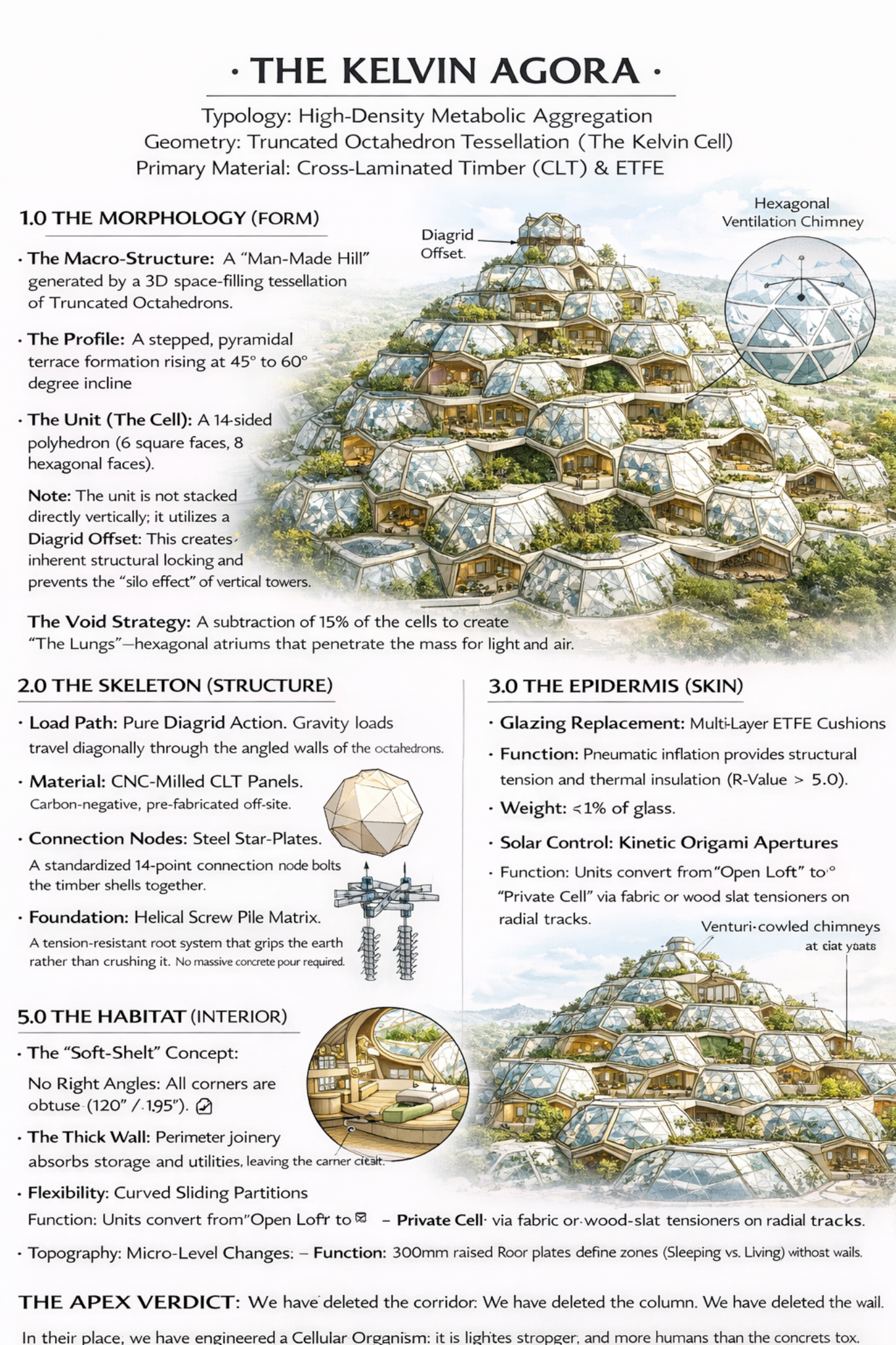
The Kelvin Agora — externally branded as Project LanternHill — is compelling geometry.
But the geometry is not the breakthrough.
What mattered was that the project simulated a development committee inside a computational loop.
In real estate development, architecture does not move forward because it is elegant. It moves forward because it survives tension: between architect and engineer, between sustainability goals and pro forma, between planning rhetoric and underwriting discipline.
That tension is normally slow, fragmented, and human.
In this case, it was compressed.
The project began with a simple question:
Housing is too expensive. People always say no to tall blocky buildings. What should we do?
That question is not just spatial. It is political and financial. Public resistance to “blocky” buildings often encodes concerns about shadow, scale, displacement, and identity.^[1] But even if public perception is addressed, a second force remains: capital.
This is where the disagreement mattered.
Architecture vs. Capital Is the Real Conflict
To understand what happened, it helps to restate the structure of development.
An architect optimizes for spatial coherence, daylight, circulation, and meaning.
A lender optimizes for variance reduction, insurance treatment, exit strategy, and comparables.
An engineer optimizes for structural clarity and constructability.
A city optimizes for code compliance and political defensibility.
These optimization functions are not aligned.
They negotiate.
The Kelvin thread recreated that negotiation.
One AI agent pushed toward formal transformation — rejecting orthogonal defaults and questioning the rectangular prism as inevitability.
The other agent pushed toward institutional survivability — questioning cost volatility, fire ratings, fabrication risk, and financing appetite.
The disagreement was not aesthetic.
It was structural.
Act I — Formal Ambition
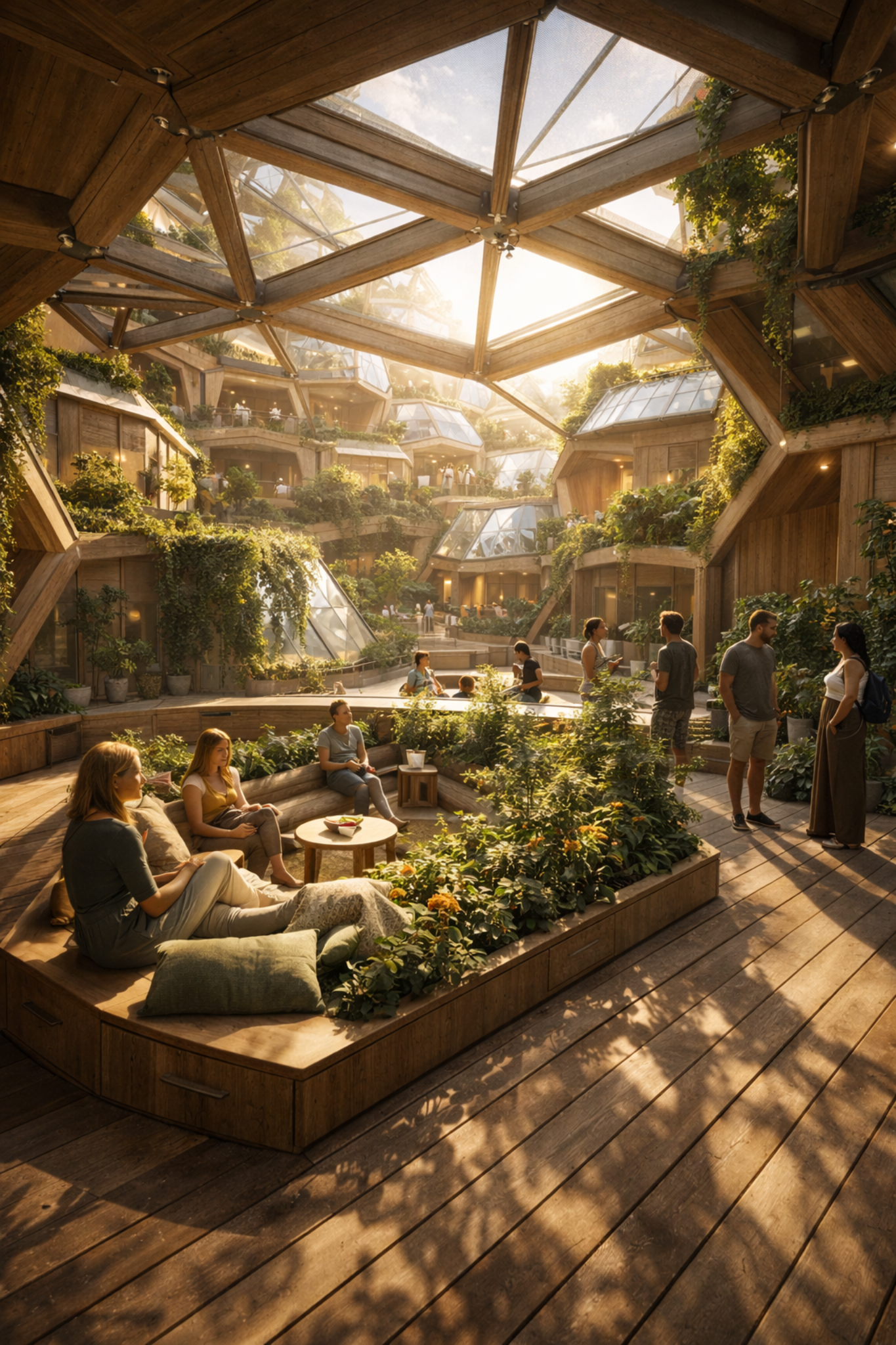
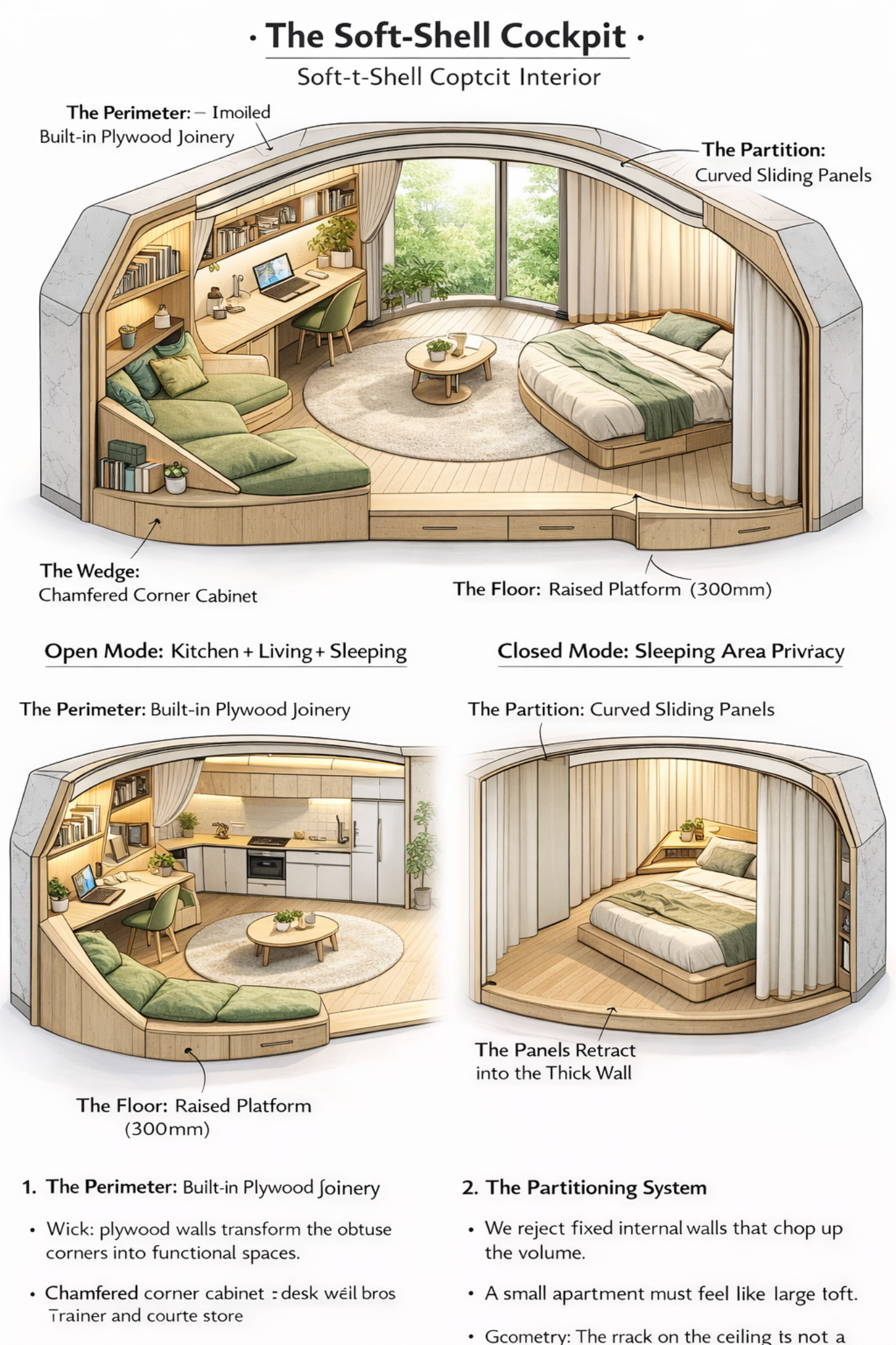
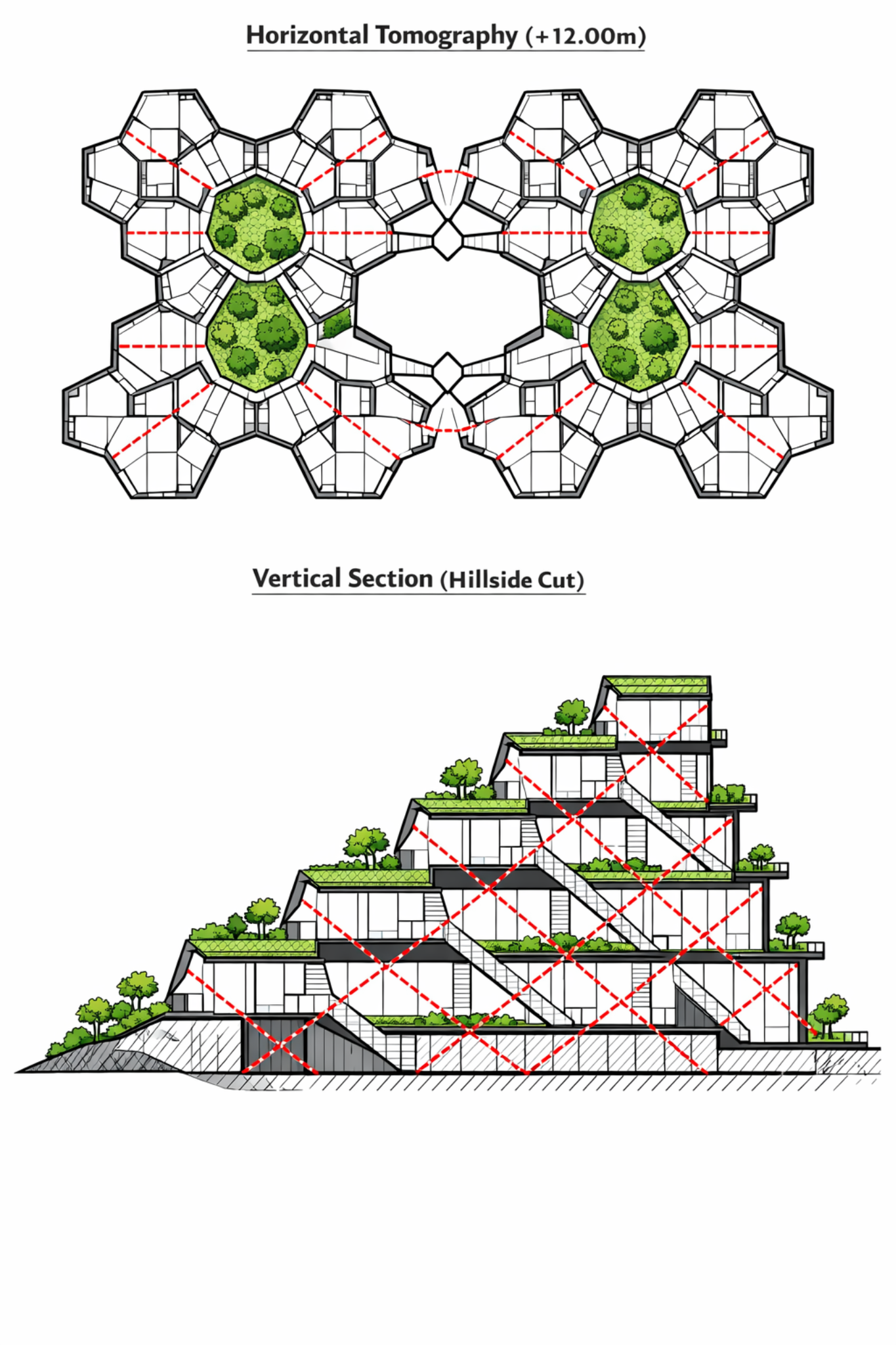
The first pass through the system produced a non-cubic aggregation of truncated octahedrons, supported by mass timber diagrid logic, terraced social lattices, passive stack ventilation, and ETFE communal atriums.
The geometry was defended structurally.
The envelope was defended environmentally.
The economics were framed optimistically.
Prefabrication and DfMA can compress schedules when repetition is high.^[2] Mass timber erection can accelerate dry-in under favorable conditions.^[3] The proposal argued that form could become leverage rather than liability.
This is how visionary architecture behaves.
It expands possibility.
But possibility alone does not close loans.
Act II — Institutional Compression
The second evaluation introduced friction.
Not aesthetic critique.
Institutional critique.
- CLT is not universally cheaper once detailing and insurance are priced in.^[3]
- Passive ventilation rarely eliminates HVAC in multifamily housing.
- ETFE introduces durability and acoustic questions at residential scale.
- High geometric uniqueness increases fabrication and QA/QC risk.
- ROI assumptions must survive conservative underwriting.
Timber height allowances vary by jurisdiction.^[3] Lenders prefer typologies with known performance histories. ESG positioning may influence valuation, but only when risk remains controlled.^[4]
The concept was not dismissed.
It was normalized.
This is what development committees do.
They reduce variance.
The Synthesis Was the Real Work
The pivot that followed mirrored real-world negotiation.
- Retain a concrete core for seismic and permitting familiarity.
- Preserve an orthogonal structural grid internally.
- Limit non-orthogonal geometry to perimeter modules.
- Restrict ETFE to communal atrium zones.
- Cap unique node and panel counts.
- Constrain height to 8 stories (Type IV-C mass timber).
In other words:
Radicalize the edge.
Standardize the core.
The ambition did not disappear. It was bounded.
This is how projects move from rendering to reality.
Why the Disagreement Matters
The important insight is not that two models had different instructions.
It is that structured disagreement replicated institutional governance.
Development is not a linear pipeline from idea to construction.
It is an adversarial alignment process between incompatible optimization targets.
Normally, that alignment unfolds over months of meetings, markups, and committee sessions.
In this case, it unfolded inside a computational loop.
The geometry survived because it was stress-tested.
The economics survived because they were challenged.
The result was not purity.
It was viability.
From Prompting to Governance
Prompting was not the headline. Governance was.
What changed in this experiment was speed and explicitness.
Instead of waiting for friction to emerge in separate rooms — architect’s office, lender’s call, city review — the friction was simulated intentionally.
The loop looked like this:
- Generate under expansive formal assumptions.
- Inject institutional constraints.
- Translate claims into measurable risk variables.
- Regenerate under tightened bounds.
- Export artifacts ready for BIM, cost, and pro forma review.
This is not just AI-assisted design.
It is computational governance.
Toward Automated Negotiation
The next step is not more ambitious geometry.
It is formalizing the negotiation layer:
- Automated parsing of design claims into cost variables
- Code overlays tied to jurisdictional datasets
- Carbon modeling triggered by structural choice
- Risk scoring based on uniqueness and fabrication complexity
- Regeneration under explicit risk thresholds
Every narrative claim becomes a parameter.
Every parameter becomes testable.
Every iteration becomes traceable.
That is the transition from aesthetic AI to infrastructural AI.
Beyond Architecture
The pattern extends beyond housing.
Any capital-intensive system — energy infrastructure, biotech, transportation, manufacturing — operates under competing optimization functions.
Vision expands.
Institutions compress.
If AI systems can be configured to embody those functions and negotiate transparently, complex projects may converge faster.
The future is unlikely to belong to a single omniscient agent.
It is more likely to belong to coordinated, intentionally differentiated agents that simulate institutional tension.
The Conservative Conclusion
The box is not obsolete.
But it is no longer unquestioned.
The most significant shift in this experiment was not material — concrete to timber — but procedural: from single-agent generation to simulated institutional negotiation.
Project LanternHill may or may not be built.
The transferable asset is the loop that produced it.
The next implementation phase inside OpenClaw is the addition of automated arbitration scoring across cost, code, and carbon — turning disagreement from narrative exercise into executable infrastructure.
Contextual Recommendation
If geometry is secondary, systems are primary.
Primary Design Co. is developing structured, multi-agent design engines that convert intent into executable artifacts through constrained negotiation loops.
This post documents one prototype.
The next release will formalize the negotiation layer.
References
^[1]: Kunda, Z. (1990). “The Case for Motivated Reasoning.” Psychological Bulletin, 108(3), 480–498.
^[2]: McKinsey & Company. (2019). Modular construction: From projects to products.
^[3]: International Code Council. (2021). International Building Code: Tall Mass Timber Provisions.
^[4]: MSCI Research. (2022). ESG and Real Estate Valuations.