HLSF as Interface
Most generative geometry is presented as spectacle. It dazzles, but it does not teach. The recursive field above is not ornament. It is an instrument.
By instrument, I mean a structure that constrains interaction in order to expose rules. A telescope disciplines light to reveal celestial order. A microscope disciplines magnification to reveal cellular structure. The HLSF field disciplines adjacency and scale to reveal how hierarchy behaves under pressure.
Its three parameters—n (branching factor), L (depth), and internal scale—are constraint multipliers. Increase n and adjacency multiplies. Increase L and propagation deepens. Reduce scale and separation is preserved. What appears as light is constraint made visible.
What appears as light is actually constraint propagation.
From Spectacle to Instrument
The difference between spectacle and instrument is whether a system teaches structure.
Spectacle maximizes surface variation. Instrumentation exposes invariants.
When n increases in the HLSF generator, sibling nodes at each depth form complete graphs within their local cluster. Edge density grows quadratically with group size. At low values, the structure is legible. At higher values, adjacency saturates perception. What looks like visual noise is in fact the visible consequence of density growth.
This is not accidental. The code includes guardrails: depth caps, node budgets, draw-level limits. These are computational necessities, but they are also epistemic signals. Without constraints, the structure collapses into indistinguishability.
Recursive systems behave this way broadly. Hierarchical organization allows complex systems to scale without total collapse, but only under constraint.^[1]
The key insight is that recursion does not simply repeat form; it propagates structural rules across levels. Each cluster mirrors its parent, scaled and positioned according to the same generative logic. The result is a visible model of hierarchical propagation.
Recursion, Hierarchy, and the Shape of Thought
Hierarchical modeling is not merely a programming convenience. It is one of the dominant frameworks for understanding cognition. Predictive processing models, for example, describe perception as layered inference across nested levels of abstraction.^[1]
In such models, higher levels encode coarse structure; lower levels refine detail. Information flows upward as error signals and downward as predictions. The important feature is not metaphorical resemblance, but structural alignment: cognition itself appears to rely on recursive constraint across levels.
The HLSF field operationalizes a similar principle in geometric form.
At level L = 1, we observe a single ring of siblings orbiting a center. At L = 2, each sibling becomes its own center, propagating structure outward. By L = 4 or 5, adjacency explodes unless scale contracts sufficiently. The system teaches something immediately visible: without contraction, depth produces overload.
This mirrors a broader principle in hierarchical systems: scaling requires compression.^[1]
The depth cap in the interface is not merely about preventing browser crashes. It is a structural demonstration of bounded cognition. Infinite recursion is computationally definable. It is not computationally affordable.
The instrument makes that limit visible.
Networks, Density, and Scaling Laws
If recursion explains vertical structure, networks explain horizontal pressure.
Within each cluster, siblings connect pairwise. For a cluster of size n, the number of possible edges is n(n−1)/2. This quadratic growth quickly shifts a system from readable to saturated.
At n = 6, there are 15 edges. At n = 20, there are 190. At n = 40, there are 780.
Legibility collapses long before mathematics does.
This is a well-established property of networks: connectivity density increases rapidly with node count, altering behavior and flow characteristics.^[2] Dense networks amplify signal diffusion but also amplify noise. Past a certain threshold, additional connectivity ceases to increase intelligibility.
The HLSF instrument exposes this inflection point visually.
When n rises above roughly 20 in the 2D analog view, polygonal recursion collapses into opacity. Lines overlap faster than the eye can segment them. The structure still exists, but perception cannot parse it. In 3D, additive blending produces luminous fog. The system has not failed. The observer has reached a processing limit.
This is where interface design becomes epistemology.
In complex systems research, hierarchical modularity is one solution to network overload.^[2] Clusters reduce global connectivity while preserving local coherence. The HLSF structure does precisely this: adjacency is dense locally but constrained globally by recursive scaling. Without scale contraction, deeper levels would intersect destructively and produce indistinguishable mass.
The node budget inside the generator enforces another boundary. A soft cap prevents more than approximately 150,000 visible points. This is framed as a performance safeguard. It is also a demonstration of computational economics: resources are finite, even in virtual systems.
There is a deeper implication here for the AGI economy.
Large models scale parameters into the billions. Their internal adjacency graphs are incomprehensible to direct inspection. Human reasoning, by contrast, operates within tight working-memory constraints. When we design interfaces that allow n and L to vary interactively, we are effectively simulating scaling pressure in a visible domain.
The user becomes the governor of complexity.
This governance role is not decorative. It mirrors the human position in model-mediated systems: selecting depth, constraining branching, imposing limits before collapse.
Perception, Overload, and Interface Discipline
The collapse you observe at higher values of n is not aesthetic failure. It is perceptual saturation.
Human visual processing does not scale linearly with stimulus density. Crowding effects, attentional limits, and working-memory constraints sharply bound how many discrete elements can be parsed simultaneously.^[3] When adjacency increases beyond segmentation capacity, structure becomes glare.
In the 2D analog view, this threshold is visible. For small n, recursive polygons remain distinct. Edges are countable. Centers are locatable. Beyond a certain branching factor, the interior becomes saturated with intersections. The pattern persists mathematically, but not phenomenologically.
The instrument therefore teaches a non-negotiable rule: more structure does not always produce more understanding.
This is why the interface enforces limits.
The depth slider is capped dynamically based on node budget. The renderer caps point counts. Edge drawing is truncated at deeper levels. These are practical safeguards. But they are also demonstrations of bounded rationality. Unbounded recursion is definable in theory; it is unusable in practice.
Limitation is the condition of legibility.
To make this explicit, consider the generative hierarchy as a structural map:
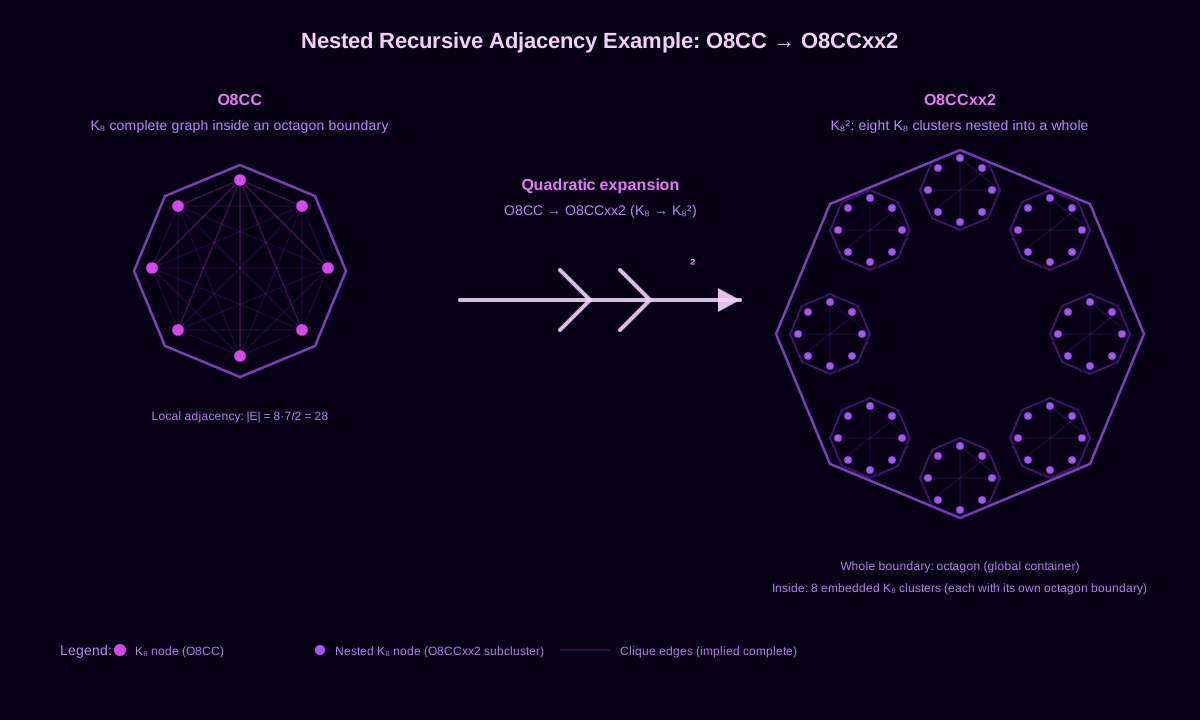
Figure 1. Recursive propagation of branching factor (n) across depth (L), with scale contraction preserving separation.
Each parent node generates n children at scaled radius. Each level multiplies adjacency locally while compressing spatial extent globally. Without scale contraction, recursive levels would overlap destructively. Without adjacency constraint, local density would overwhelm perception.
The geometry is therefore not arbitrary. It is disciplined.
This discipline parallels research in cognitive load and visual complexity: performance declines as element density increases beyond segmentation capacity.^[3] What the HLSF field does is convert that abstract principle into interactive demonstration.
The limit becomes experiential rather than theoretical.
The AGI Economy and Instrumented Thinking
The relevance of this instrument extends beyond geometry.
In large-scale AI systems, internal structure grows far beyond direct human inspection. Parameter counts increase. Internal representations deepen. Connectivity expands. Yet the human operator remains bounded by perception and working memory.
The asymmetry is structural.
Models scale adjacency faster than humans scale comprehension. What remains available to the human is not inspection, but governance: setting branching limits, constraining depth, selecting regimes of operation.
The HLSF interface makes this asymmetry visible.
When you adjust n, you increase local connectivity. When you increase L, you multiply recursive propagation. When you reduce internal scale, you compress spatial separation to preserve legibility. These operations mirror decisions made when deploying or configuring AI systems: model size, inference depth, context window, sampling temperature.
The human role is not to match model complexity. It is to regulate it.
This is what I mean by instrumented thinking.
An instrument does not replace cognition. It shapes the conditions under which cognition operates. A well-designed recursive interface externalizes structural properties that would otherwise remain abstract: combinatorial growth, density thresholds, constraint necessity.
In an AGI economy, literacy will increasingly mean the ability to reason about scaling pressure before collapse occurs.
The depth cap in the HLSF system is analogous to a context window limit. The node budget is analogous to compute allocation. The perceptual saturation threshold is analogous to interpretability limits. These are structural correspondences, not decorative analogies.
If we do not build instruments that expose these boundaries, we risk mistaking expansion for clarity.
Recursive literacy is therefore not about appreciating fractals. It is about understanding that scaling multiplies constraint requirements.
The field above demonstrates this without rhetoric. Increase n until adjacency overwhelms. Increase L until scale must contract or collision occurs. Remove contraction and structure dissolves.
The lesson is consistent: complexity without discipline produces opacity.
Conclusion: Designing for Recursive Literacy
The HLSF field is not a metaphor for intelligence. It is a scaling simulator.
Depth multiplies adjacency. Connectivity increases density. Perception fails before mathematics does. Scaling without contraction produces opacity.
These are structural facts, not aesthetic impressions.
In a computational environment where systems scale faster than human comprehension, the central design question becomes: how do we make scaling visible before it becomes opaque?
Recursive instruments answer that question by externalizing hierarchy.
They allow users to feel the pressure of branching factors. They allow users to see the cost of depth. They allow users to observe the threshold at which structure becomes glare. These observations are not theoretical. They are experiential.
The discipline embedded in the interface—node budgets, depth caps, adjacency limits—is not defensive programming. It is epistemic architecture.
If future work with advanced AI systems is to remain legible, we will need more such instruments. Not dashboards that report outcomes, but environments that model constraint propagation directly.
Recursive literacy may become a prerequisite for meaningful human governance in complex computational systems.
The light field above is one small demonstration of that principle.
If you want to experiment with recursive structure directly, the PDCo Dev Studio provides a sandbox for building and manipulating hierarchical systems in real time. The goal is not aesthetic output but structural literacy: learning to see scaling pressure before it becomes collapse.
Explore: https://dev.primarydesignco.com
References
^[1]: Friston, K. (2010). “The free-energy principle: a unified brain theory?” Nature Reviews Neuroscience, 11(2), 127–138.
^[2]: Barabási, A.-L. (2016). Network Science. Cambridge University Press.
^[3]: Pelli, D. G., & Tillman, K. A. (2008). “The uncrowded window of object recognition.” Nature Neuroscience, 11(10), 1129–1135.