Facts Anchor Us to Reality; Illusions Unhinge Us
Interactive figure (view on site): Verification as Epistemic Infrastructure.
Figure 1. Verification as Epistemic Infrastructure.
This schema shows verification as a system: feedback, friction, and correction that allow disagreement to converge instead of drift.
Introduction
This essay uses numbered footnotes to anchor empirical claims.
Modern societies do not fail because people disagree. They fail when disagreement no longer occurs within a shared frame of reference—when people stop recognizing the same kinds of evidence as binding.
This shift rarely appears as a rejection of reality. It presents as sincerity. Beliefs feel true. Narratives feel coherent. Moral confidence intensifies. What erodes is verification: the ability to check claims independently of identity, affiliation, or emotional resonance.1
Facts are not sacred objects. They are coordination tools. They allow people who differ in values to reason about external constraints that do not negotiate. When verification norms hold, disagreement remains legible and revisable. When they collapse, belief becomes insulated from correction and society drifts into epistemic chaos—not because people stop caring, but because care is redirected toward identity affirmation.2
The central crisis is not misinformation itself, but the degradation of verification as a social norm. Without shared methods for checking claims, even true statements lose stabilizing power. The result is not pluralism, but incompatible realities. As shown in Figure 1, verification functions as epistemic infrastructure, not moral consensus.
These dynamics are inseparable from media systems and ongoing patterns of belief formation.
As shown in Figure 2, shared verification gently pulls disagreement toward convergence while emotional reinforcement accelerates divergence.
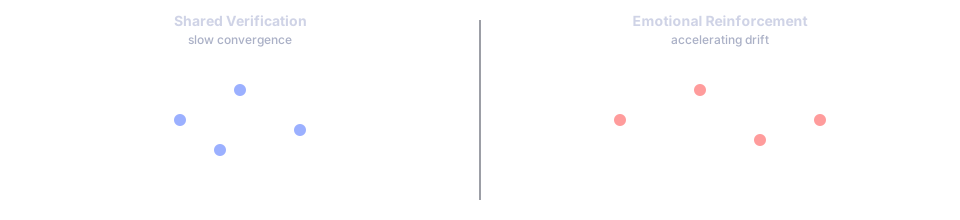
Figure 2. Verification vs. Drift.
Shared verification gently pulls disagreement toward convergence. Emotional reinforcement accelerates divergence by suppressing corrective feedback.
The Coordination Problem (Not the Truth Problem)
Public debate is often framed as a contest between truth and falsehood. That framing misses the deeper issue. Societies have always contained error. What distinguishes stability from instability is correction.
Facts matter because they anchor coordination. Traffic laws, engineering standards, and scientific claims derive authority from external checkability, not proclamation. When verification norms weaken, claims are judged less by evidence than by resonance—whether they fit identity, emotion, or group loyalty.
Echo chambers are dangerous not because they filter information, but because they shift evaluation criteria. Repetition substitutes for verification.3 Familiarity is mistaken for reliability. Confidence becomes evidence.
This is not a problem of ignorance. Educated individuals are often more vulnerable because they are better at rationalizing motivated conclusions.4 From a systems perspective, this is a coordination failure: feedback loops amplify divergence, and disagreement hardens into identity boundaries.
The alternative is not enforced consensus, but recommitment to verification as a shared civic practice.
The Epistemic System at a Glance
- Identity binds belief. A workplace meeting where dissent risks exclusion shows how self-concept can override evidence.
- Media amplifies coherence. A single emotionally charged share can outpace a careful correction.5
- Cost asymmetry suppresses correction. A public retraction rarely spreads as far as the original claim.6
- Verification introduces friction. Pausing before sharing creates the delay that makes checking possible.
- Friction enables convergence over time. Small corrections compound, slowly re-aligning disagreement with shared constraints.
Shared Illusions vs Fractured Realities
Shared illusions often feel preferable to fractured realities. A population that believes the same falsehoods can still coordinate. This explains the historical power of myths and simplified narratives.
The danger is not coordination itself, but severing feedback from reality.
Shared illusions suppress correction. As long as conditions remain forgiving, they appear stable. When conditions change, collapse is abrupt and costly. Fractured realities surface conflict earlier. They are uncomfortable, but they preserve the possibility of correction.
WMDs in Iraq illustrate the risk.7 The belief persisted not because dissent was absent, but because incentives aligned to marginalize falsification.8 Coordination succeeded by disabling verification. Correction came only after cost became irreversible.
The real tradeoff is not harmony versus chaos. It is short-term coherence versus long-term adaptability.
A Short Case: Weapons of Mass Destruction in Iraq
The pre–2003 consensus around Iraqi weapons of mass destruction illustrates the danger of shared illusion. Across political parties, media institutions, and allied governments, the belief that Iraq possessed active WMD programs became dominant. Dissenting assessments existed, but they were marginalized as inconvenient rather than evaluated as falsification attempts.
What made this a shared illusion was not the absence of intelligence, but the alignment of incentives. The belief coordinated action across institutions precisely because it felt coherent and morally clarifying. It simplified ambiguity into urgency.
When the illusion collapsed—after invasion rather than before—the cost of correction was no longer abstract. It was human, financial, and geopolitical. The shared belief had enabled coordination while simultaneously disabling verification. Alternative interpretations were not tested; they were treated as obstacles.
The lesson is not partisan. It is structural. When belief coherence substitutes for evidentiary discipline, institutions lose the ability to stop themselves.
Why Shared Illusions Feel Safer
Shared illusions offer psychological relief. They reduce cognitive load. They align identity with belief. Social psychology shows that agreement within a group lowers perceived threat and increases confidence, regardless of accuracy.9 Certainty feels like competence.
Fractured realities do the opposite. They demand ongoing evaluation. They force individuals to tolerate ambiguity and social friction. They expose belief to challenge, which feels destabilizing even when it is epistemically healthy.
Modern media systems exploit this asymmetry. Algorithms reward engagement, not correction.10 Content that reinforces a shared narrative spreads faster than content that introduces uncertainty.11 The result is an environment where illusions scale efficiently, while verification struggles to compete.
The Real Tradeoff
The real choice is not between harmony and chaos. It is between short-term coherence and long-term adaptability.
Shared illusions optimize for immediate coordination at the expense of resilience. Fractured realities sacrifice comfort but preserve the possibility of correction. Societies that survive complexity tend to tolerate the discomfort of disagreement rather than anesthetize it with certainty.
The critical variable is verification. When verification norms are strong, disagreement converges over time. When they are weak, agreement diverges from reality.
The next section shows how identity protection, media amplification, and incentive dynamics form a single feedback system that makes verification feel like betrayal rather than responsibility.
The Feedback System: Identity, Media, Incentives
Belief persistence is rarely about ignorance. It is about identity protection. Once beliefs bind to self-concept, evidence feels like a threat rather than an input—think of a team meeting where dissent risks exclusion, or a family argument where changing your mind reads as disloyalty.
Motivated reasoning is asymmetric.12 Supporting evidence is accepted quickly; threatening evidence is scrutinized or reframed. Over time, belief revision feels like betrayal. Verification becomes adversarial.
As shown in Figure 3, these dynamics are self-reinforcing: confidence can increase even as external correction weakens.13
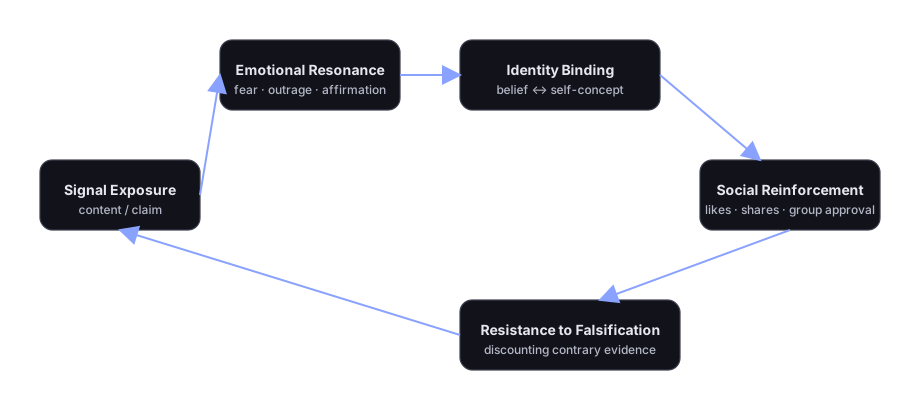
Figure 3. Belief Lock-In Feedback Loop.
As beliefs bind to identity, social reinforcement suppresses falsification. Confidence increases even as external correction weakens.
Why Education Does Not Immunize Against This
Higher education increases argumentative skill, not epistemic neutrality.14 Educated individuals are often better at constructing post-hoc rationalizations for preferred conclusions. They can cite sources selectively, contextualize inconvenient data away, and frame uncertainty as bias when it contradicts their position.
This is why exposure to political targeting can have paradoxical effects. Awareness of manipulation increases skepticism toward out-groups while reinforcing confidence in in-group narratives. “I know how this works” becomes a shield against self-scrutiny.
The issue is not intelligence. It is asymmetric application of verification standards.
Media Amplification as Epistemic Weather
Modern media systems do not primarily deliver information. They shape the conditions under which information is interpreted. Like weather, they influence behavior without requiring conscious attention.
Algorithmic systems amplify content that generates engagement: outrage, affirmation, fear, moral clarity. A single emotionally charged share can outpace a careful correction. Over time, users are trained—implicitly—to associate intensity with relevance and repetition with reliability.
Verification suffers under these conditions because it is slow, socially costly, and rarely rewarded in the short term. Correction does not go viral. Retractions feel anticlimactic.15 Ambiguity does not satisfy.
As shown in Figure 4, when amplification outweighs verification, networks fragment into internally coherent but incompatible realities.
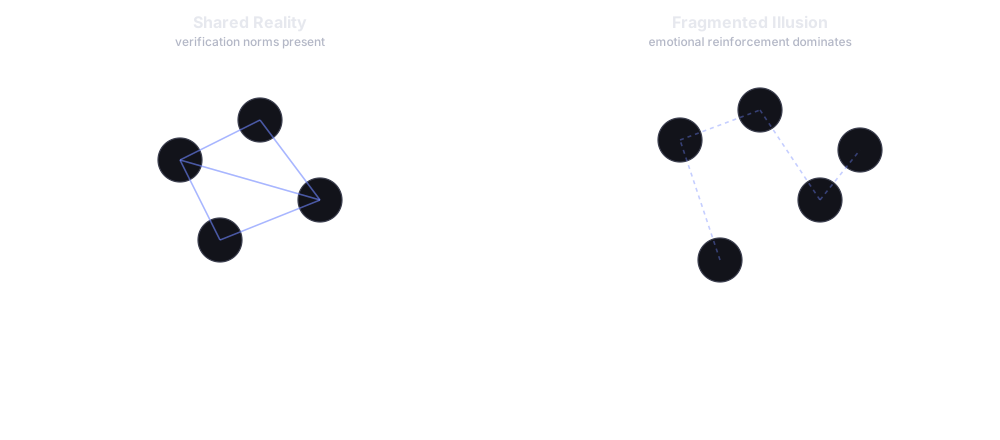
Figure 4. Shared Reality vs Fragmented Illusion.
When verification norms exist, disagreement converges. When amplification outweighs verification, networks fragment into internally coherent but incompatible realities.
Incentives and Epistemic Drift
The erosion of verification norms follows incentives. When reality becomes optional, it is rarely because people suddenly lose interest in truth. It is because systems reward belief alignment more reliably than accuracy.
In environments where attention is monetized, emotional resonance outperforms evidentiary rigor. Claims that provoke fear, affirmation, or outrage travel faster than claims that require qualification. Over time, participants internalize these dynamics. They learn—often unconsciously—which forms of expression are rewarded and which are ignored.
Power accelerates this drift. When institutions, leaders, or movements benefit from belief stability more than from belief accuracy, verification becomes a liability. Correction introduces friction. Friction slows momentum. In competitive environments—political, economic, cultural—there is constant pressure to minimize that friction.
The result is a subtle inversion: facts are no longer the substrate upon which narratives are built; narratives become the filter through which facts are permitted entry.
Cost Asymmetry & Error Suppression
Illusions scale because dissent is costly and error is delayed. Challenging shared narratives risks social or professional loss. Accepting them carries little immediate penalty.
Complex systems depend on error signals. Suppressing those signals does not eliminate error; it delays detection. Delayed detection increases failure magnitude. Shared illusions feel stable precisely because they mute correction.
The moralization of belief accelerates this collapse. When beliefs become markers of virtue, doubt becomes disloyalty and inquiry becomes aggression. Values replace evidence, and dogma replaces revision.
The Collapse of Error Signals
Complex systems depend on error signals to remain adaptive. In engineering, these signals trigger correction before failure cascades. In biological systems, pain serves this role. In epistemic systems, falsification is the equivalent mechanism.
When societies suppress error signals—by dismissing inconvenient facts, attacking messengers, or reframing contradiction as hostility—they do not eliminate error. They delay its detection. Delayed detection increases the magnitude of eventual failure.
This is why shared illusions are so dangerous. They feel stable precisely because they mute corrective feedback. By the time reality reasserts itself, adjustment is no longer incremental. It is abrupt.
History repeatedly confirms this pattern.16 Financial bubbles persist not because warnings are absent, but because warnings are discounted. Institutional failures unfold not because no one noticed risk, but because noticing it carried no authority.
Epistemic collapse is rarely sudden. It is preceded by long periods in which reality is technically visible but functionally ignored.
As shown in Figure 5, shared illusions suppress error signals, producing apparent stability until correction becomes abrupt and costly.
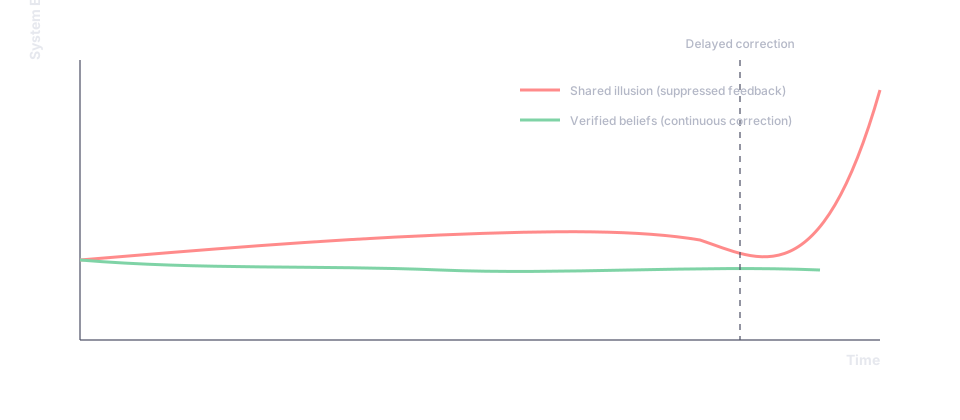
Figure 5. Illusion Stability vs. Reality Correction Over Time.
Shared illusions suppress error signals, producing apparent stability until correction becomes abrupt and costly. Verification introduces friction early, enabling slower but survivable adaptation.
The Moralization Trap
One of the most corrosive effects of epistemic drift is the moralization of belief. When beliefs become markers of virtue, verification is recast as suspicion. Doubt becomes disloyalty. Inquiry becomes aggression.
This transformation is subtle. It often begins with the claim that certain truths are “settled” in a way that exempts them from ongoing scrutiny. Over time, the boundary between moral commitment and empirical assertion blurs. Disagreement is interpreted not as error, but as vice.
Once this happens, correction becomes almost impossible. Evidence no longer addresses claims; it threatens identities. The system loses the ability to distinguish between being wrong and being bad.
This is not a call for moral neutrality. Values matter. But values cannot substitute for evidence without collapsing into dogma. When belief is protected by moral immunity, it no longer evolves.
Verification as a Civic Practice
Verification is not reserved for experts. It is a civic habit.
Four norms matter more than any single fact:
• Falsifiability — claims must be checkable in principle • Triangulation — independent agreement matters more than repetition • Time delay — slowing endorsement reduces emotional capture • Probabilistic language — confidence gradients lower the cost of revision
These practices do not eliminate bias. They contain it.
Several norms matter more than any single fact.
First, falsifiability: a claim that cannot, even in principle, be proven wrong cannot anchor coordination. It may inspire, but it won’t correct. Healthy belief systems treat disconfirming evidence as valuable input, not as hostility.
Second, source triangulation: no single outlet, institution, or influencer is sufficient. Independent agreement across methods and incentives matters more than repetition inside one channel—especially in algorithmic environments where redundancy can be manufactured.
Third, time delay: many errors persist because beliefs are endorsed faster than they can be checked. Slowing endorsement—especially before sharing—reduces emotional capture and improves accuracy.
Fourth, probabilistic language: treating beliefs as degrees of confidence lowers the cost of revision. “This seems likely given what I know” keeps beliefs corrigible. “This must be true” recruits identity defense.
These practices do not eliminate bias. They contain it. Bias is a constant; norms determine whether it compounds or cancels out.
Why This Is Encouraging, Not Pessimistic
It is tempting to read the current information environment as evidence that shared reality is impossible. That conclusion mistakes difficulty for futility. The fact that verification requires effort does not mean it cannot scale. It means it must be deliberately cultivated.
History offers reasons for optimism. Scientific communities, legal systems, and safety-critical industries have all developed verification norms precisely because error carried consequences. Peer review, cross-examination, and redundant checks exist not because humans are rational, but because they are not. These practices work when they are socialized, not moralized.
The same is true in civic life. Verification does not require that people abandon values or identity. It requires that they distinguish between what they want to be true and what they have reason to believe is true. That distinction is learnable. It is teachable. It is already practiced in many domains of everyday life.
What undermines verification is not disagreement, but the belief that sincerity is sufficient. Feeling certain is not the same as being correct. Caring deeply does not exempt a claim from external checks. In fact, the more consequential a belief is, the higher the standard of verification it deserves.
From Diagnosis to Design
If facts function as coordination infrastructure, then verification norms are a design problem. Platforms, institutions, and communities can either lower or raise the cost of checking claims. They can reward confidence or reward accuracy. They can treat revision as weakness or as competence.
The probability generator below makes this visible. It shows how small behavioral shifts—pausing before sharing, seeking independent confirmation, tolerating uncertainty—change outcomes at scale. Not because people become better, but because systems amplify whatever norms they are given.
The choice, then, is not between certainty and chaos. It is between narratives that insulate themselves from correction and practices that remain responsive to reality.
Re-Anchoring Without Authoritarianism
Shared reality is not sustained by agreement, but by shared methods. Courts, science, and engineering tolerate fierce disagreement while enforcing verification.
Re-anchoring reality is a design problem. It requires lowering the cost of verification and raising the cost of unsupported certainty. Systems must reward correction rather than punish it, and treat belief revision as competence rather than weakness.
This is difficult in environments optimized for speed and scale—but difficulty does not imply impossibility.
Why This Still Matters
It is tempting to conclude that epistemic fragmentation is an irreversible consequence of modern media. That conclusion confuses exposure with inevitability. Technologies shape behavior, but they do not dictate norms. Norms are reinforced—or resisted—through practice.
Shared reality has always been fragile. What has changed is the speed at which illusion can propagate and the scale at which correction can be delayed. The underlying requirement remains the same: disciplined attachment to claims that can be checked independently of how they feel.
The alternative is not pluralism. It is epistemic isolation—millions of internally coherent worlds colliding with external constraints they no longer recognize.
The probability generator that follows is not meant to dramatize this risk. It is meant to normalize it. Once belief formation is understood as a system with inputs, feedback, and incentives, moral panic gives way to design thinking. The question stops being “Who is wrong?” and becomes “What are we rewarding?”
As shown in Figure 6, the generator translates verification behaviors into system-level divergence or convergence.
The Probability Generator (Conceptual Bridge)
Interactive figure (view on site): Belief Divergence Probability Generator.
Figure 6. Belief Divergence Probability Generator.
This interactive model visualizes how small changes in verification behavior compound into large systemic effects.
The key insight the generator reinforces is simple: small changes in verification behavior produce large systemic effects over time.
The final section returns to the opening question and argues that verification—not agreement—is the only stable alternative.
Conclusion: Choosing Anchors Over Narratives
The choice between fractured realities and shared illusions is false. Both emerge from the same failure: the loss of shared verification norms.
Facts anchor societies not by moral authority, but by resistance. They push back. They keep disagreement tethered to the same world. When verification fails, belief drifts inward, bound to identity rather than constraint.
Verification is not cynicism. It is civic responsibility. In complex societies, corrigibility is not optional. It is the price of coordination.
Facts anchor us not because they comfort us, but because they correct us.
Contextual Recommendation
Primary Design Co. explores how systems—technical, social, and institutional—can be designed to support coordination under uncertainty. Ongoing work examines verification, traceability, and decision-making as design problems rather than moral abstractions.
Explore related projects and frameworks here: Explore Primary Design Co’s ongoing work
This essay treats verification not as a moral virtue, but as infrastructure: a system that allows disagreement, revision, and learning without collapse.
Notes
References
Kahneman, D. (2011). Thinking, Fast and Slow. Farrar, Straus and Giroux.
Kunda, Z. (1990). “The Case for Motivated Reasoning.” Psychological Bulletin, 108(3), 480–498.
Lewandowsky, S., Ecker, U. K. H., Seifert, C. M., Schwarz, N., & Cook, J. (2012). “Misinformation and Its Correction.” Psychological Science in the Public Interest, 13(3), 106–131.
Sunstein, C. R. (2017). #Republic: Divided Democracy in the Age of Social Media. Princeton University Press.
Pariser, E. (2011). The Filter Bubble. Penguin Press.
Lippmann, W. (1922). Public Opinion. Harcourt, Brace & Company.
Haidt, J. (2012). The Righteous Mind. Pantheon Books.
Zuboff, S. (2019). The Age of Surveillance Capitalism. PublicAffairs.
Oreskes, N., & Conway, E. M. (2010). Merchants of Doubt. Bloomsbury Press.
Vosoughi, S., Roy, D., & Aral, S. (2018). “The Spread of True and False News Online.” Science, 359(6380), 1146–1151.
U.S. Senate Select Committee on Intelligence. (2004). Report on the U.S. Intelligence Community’s Prewar Intelligence Assessments on Iraq.
-
Kunda (1990); Haidt (2012). ↩
-
Haidt (2012); Lewandowsky et al. (2012). ↩
-
Lewandowsky et al. (2012); Sunstein (2017). ↩
-
Kunda (1990); Lewandowsky et al. (2012). ↩
-
Vosoughi, Roy, & Aral (2018). ↩
-
Vosoughi, Roy, & Aral (2018). ↩
-
U.S. Senate Select Committee on Intelligence (2004). ↩
-
U.S. Senate Select Committee on Intelligence (2004); Oreskes & Conway (2010). ↩
-
Haidt (2012). ↩
-
Sunstein (2017); Pariser (2011). ↩
-
Vosoughi, Roy, & Aral (2018). ↩
-
Kunda (1990). ↩
-
Lewandowsky et al. (2012). ↩
-
Kunda (1990); Lewandowsky et al. (2012). ↩
-
Lewandowsky et al. (2012). ↩
-
Oreskes & Conway (2010); U.S. Senate Select Committee on Intelligence (2004). ↩