Design work is often evaluated as if it arrives fully formed: a finished artifact, a deployed system, a published policy. What precedes that arrival—the succession of partial models, provisional assumptions, discarded alternatives, and contextual judgments—tends to vanish from view. In many professional cultures, this disappearance is treated as natural, even desirable. The work is expected to speak for itself.

Yet the silence surrounding how work comes to be is not neutral. It shapes how future decisions are made, how errors are diagnosed, and how responsibility is assigned. When reasoning is allowed to dissolve once an outcome exists, later interpretations are forced to reconstruct intent from surface features alone. This reconstruction is rarely faithful. It substitutes inference for evidence and hindsight for judgment.

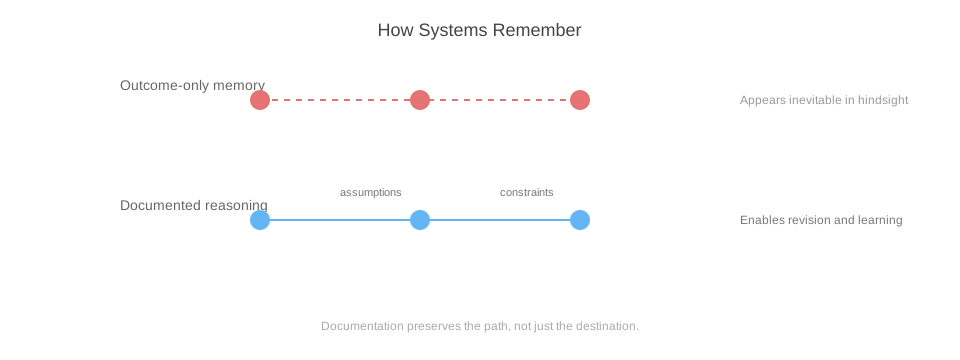
The result is a subtle but persistent distortion. Projects appear more coherent than they were. Trade-offs are remembered as inevitabilities. Contingencies harden into principles. Over time, the gap between what was actually known and what is later believed to have been known grows wide enough to misguide subsequent work.

This essay begins from the premise that such distortion is not merely a historical inconvenience but a structural weakness. In environments where complexity, uncertainty, and time are unavoidable, the absence of documented reasoning undermines the very capacity to learn. The issue is not a lack of intelligence or effort, but the absence of a durable record against which understanding can accumulate.

Documentation is often invoked as a remedy, but typically in a diminished form. It is framed as a deliverable to be produced after decisions have been made, a narrative to justify outcomes rather than a medium through which outcomes are shaped. In this role, documentation functions as explanation rather than structure. It describes what happened without materially affecting what happens next.

There is an alternative posture. Writing can be treated not as an after-action report, but as an active instrument of design. When reasoning is externalized while it is still in motion, it becomes available for inspection, critique, and revision. The act of writing does not merely record thought; it changes it.

This effect has been observed across disciplines. In philosophy, Ludwig Wittgenstein remarked that “the work of the philosopher consists in assembling reminders for a particular purpose.” The reminder, in this sense, is not a summary of a conclusion but a scaffold for attention. It draws thought back to its own conditions. In science, laboratory notebooks serve a similar function. They preserve not only results but the experimental paths that led to them, including those that failed. Their value lies precisely in their incompleteness.

Design and creative practice are no less dependent on such scaffolding. They differ from purely analytical disciplines in that they operate within spaces where criteria are negotiated rather than given. Herbert Simon emphasized that design is concerned with “how things ought to be,” a formulation that foregrounds judgment under constraint. Judgments made under one configuration of constraints are not universally transferable. Without context, they become brittle.

Writing provides that context. It captures not only what was decided, but why it appeared reasonable at the time. It records uncertainty without resolving it prematurely. It allows later readers—including the original author—to distinguish between what was known, what was assumed, and what was guessed.

This distinction matters because memory is not a reliable archive. Cognitive research has long shown that recollection is reconstructive rather than reproductive. We do not retrieve past reasoning intact; we rebuild it from fragments, colored by present understanding. In professional settings, this reconstruction often aligns conveniently with current outcomes, reinforcing a sense of inevitability that was never present at the time decisions were made.

A written record resists this drift. It anchors interpretation in contemporaneous language, preserving the texture of uncertainty and the specificity of constraint. It makes visible the provisional nature of conclusions that later appear fixed. In doing so, it enables a different relationship to revision. Change becomes a dialogue with past reasoning rather than an erasure of it.

This posture toward documentation does not assume that every thought deserves preservation. Rather, it assumes that the process by which thought becomes action is itself a legitimate object of design. The question is not whether to document, but how and when documentation exerts the most leverage.

The position advanced here is that documentation is most valuable when it participates directly in the act of thinking. When writing is deferred until after decisions have solidified, its capacity to shape those decisions has already been forfeited. When it is integrated into the process itself, it becomes a form of reflective infrastructure.

Donald Schön described professional practice as a conversation with the situation, one in which the practitioner responds to surprises by reframing the problem. “Through reflection,” he wrote, “the practitioner can surface and criticize the tacit understandings that have grown up around the repetitive experiences of a specialized practice.” Writing is one of the most effective ways to surface those tacit understandings. It forces them into language, where they can be examined rather than merely enacted.

The remainder of this essay develops this position in detail. It examines how documentation makes reasoning visible, how it supports judgment across time, how it enables traceability in complex systems, and how public records introduce accountability without demanding false certainty. Throughout, the emphasis remains on documentation as practice rather than proclamation: a means of thinking clearly in environments where clarity cannot be assumed.

Documentation and the Visibility of Reasoning

Moments of transition are where invisible reasoning becomes dangerous. When authority changes hands—between administrations, regimes, or institutional orders—decisions made under one set of assumptions are suddenly interpreted under another. If the reasoning behind those decisions is not visible at the moment of transfer, continuity gives way to improvisation, and improvisation often masquerades as reform.

Modern state transitions offer repeated evidence of this dynamic. In democratic systems, administrative continuity is typically preserved through professional civil services, briefing books, and formal handover processes. Even so, when these mechanisms fail or are bypassed, the absence of documented reasoning quickly manifests as policy incoherence. Agencies inherit mandates without understanding the trade-offs that shaped them. Programs are dismantled or expanded based on surface interpretations rather than underlying intent.

The problem becomes more acute in post-conflict or post-authoritarian contexts, where documentation is often deliberately destroyed or politically discredited. The de-Ba’athification of Iraq after 2003 provides a stark example. In an effort to purge the state of Saddam Hussein’s influence, large portions of the Iraqi administrative class were removed wholesale. Ministries were stripped not only of personnel but of institutional memory. Technical knowledge about infrastructure, supply chains, and governance routines disappeared overnight. Decisions that had been made under one regime—many of them pragmatic rather than ideological—were rendered unintelligible to those who replaced them.

The result was not a clean break with the past, but administrative paralysis. Power grids failed, ministries stalled, and reconstruction efforts were forced to relearn basic operational facts that had once been well understood. The issue was not that the prior reasoning had been correct in every instance. It was that its absence made judgment impossible. Without records explaining why systems were designed as they were, new authorities could neither revise nor reliably replace them.

Historical regime changes reinforce the same lesson. When the Soviet Union dissolved, successor states inherited vast physical infrastructures without access to the planning logic that governed them. Centralized economic decisions, once justified by ideological and logistical constraints, were abruptly exposed to market pressures without explanatory context. In many cases, enterprises were privatized or dismantled without understanding the interdependencies that had sustained them. What appeared inefficient or obsolete on the surface often concealed functional roles within a larger system that was no longer legible.

These failures are often narrated as ideological overreach or economic naïveté. Less frequently acknowledged is the epistemic vacuum in which decisions were made. Reasoning had existed, but it had not been preserved in a form that could survive political collapse. When ideology fell, explanation fell with it.

Even in stable democracies, subtler versions of this problem recur. Transitions between U.S. presidential administrations routinely expose the fragility of undocumented judgment. Policies implemented through executive discretion often rely on internal rationales that never make it into public record. When a new administration arrives, it inherits outcomes without inheriting reasons. Programs are judged by political alignment rather than by the constraints that shaped them.

This dynamic produces oscillation rather than evolution. Policies swing back and forth across administrations, not because evidence has changed, but because the reasoning behind prior decisions was never visible enough to be engaged. The state appears indecisive, when in fact it is epistemically discontinuous.

Historical continuity, where it exists, is rarely accidental. The British civil service offers a contrasting example. Its emphasis on permanent records, briefing continuity, and professional neutrality was not designed to prevent political change, but to ensure that political change did not erase institutional understanding. Ministers come and go; files remain. Decisions can be revisited because their rationales are preserved.

This preservation does not sanctify past judgment. It subjects it to scrutiny. When reasoning is visible, it can be criticized, refined, or rejected with precision. When it is invisible, critique becomes speculative. Reform turns into demolition, followed by reconstruction from incomplete memory.

The visibility of reasoning, then, is not a matter of transparency alone. It is a condition for responsible judgment under transition. Documentation allows successors to distinguish between constraints that remain binding and those that were contingent. It enables change without amnesia.

Absent such visibility, transitions reward decisiveness over understanding. Actions feel bold because they are unencumbered by context. Yet this freedom is illusory. Decisions made without access to prior reasoning are not liberated from history; they are simply blind to it.

The importance of documentation becomes clearest at these moments of handoff, when the future depends not on preserving outcomes, but on preserving the capacity to judge. The next section turns to a different domain of transition—corporate and organizational change—where similar failures of documented reasoning repeatedly undermine long-term strategy.

Design, Judgment, and Time

Corporate mergers and acquisitions are often justified as exercises in strategic foresight. Executives present them as rational responses to market conditions, technological change, or competitive pressure. Yet the history of large-scale mergers suggests a different pattern. Decisions that appear sound at the moment of execution frequently unravel over time, not because the original judgment was irrational, but because the reasoning that informed it was never preserved in a form that could survive organizational change.

The Daimler–Chrysler merger of 1998 remains one of the most frequently cited examples. At the time, it was framed as a “merger of equals” that would combine German engineering discipline with American manufacturing scale. The strategic logic, articulated publicly, emphasized complementary strengths and global reach. What remained largely undocumented were the internal assumptions about culture, governance, and decision authority that made the merger appear feasible to its architects.

As leadership changed and integration proceeded, these assumptions surfaced only through conflict. German executives operated under a model of centralized, hierarchical decision-making, while their American counterparts were accustomed to greater managerial autonomy. The judgment that these cultures could be reconciled was not wrong in principle, but it was insufficiently specified. When market conditions shifted and performance faltered, successors were left managing tensions without access to the original reasoning that had justified the risk. The merger’s failure is often attributed to “cultural mismatch,” but culture here functioned as a proxy for undocumented judgment.

A similar dynamic played out in the AOL–Time Warner merger of 2000. Executed at the height of the dot-com boom, the acquisition was presented as a convergence of old and new media. The underlying judgment assumed that distribution scale and content ownership would reinforce one another. When the market collapsed, the rationale for integration evaporated, leaving an organization burdened by incompatible incentives and governance structures.

What is notable in retrospect is not merely that the merger failed, but that it failed without a clear internal narrative explaining why it had been attempted in the first place. As leadership turned over, the strategic reasoning that had once seemed compelling was reduced to slogans. Decisions made under one set of expectations were evaluated under another, and without documentation to bridge the gap, revision became reactionary rather than analytical.

Judgment in corporate strategy is always exercised under temporal constraint. Market conditions are inferred rather than known. Technologies promise more than they deliver. Acquisitions are made in anticipation of futures that may not arrive. When reasoning is undocumented, these anticipatory judgments harden into inherited constraints. New leaders inherit structures without inheriting the assumptions that justified them.

The Hewlett-Packard–Compaq merger illustrates this inheritance problem. Initiated in 2001, the merger was defended as necessary scale in a consolidating hardware market. Internally, it relied on judgments about cost synergies, product overlap, and competitive positioning. As the industry shifted toward services and software, these judgments lost relevance. Yet the organizational structure they produced persisted, shaping decisions long after their premises had expired.

Without a durable record of why integration choices were made, later executives were forced to treat those choices as fixed realities. Strategic revision focused on adapting to the inherited structure rather than reassessing the judgments that produced it. The result was a prolonged period of strategic drift, punctuated by restructurings that addressed symptoms rather than causes.

More recent acquisitions reveal the same pattern in subtler form. When Google acquired Motorola Mobility in 2011, the stated rationale centered on patent defense and hardware experimentation. The acquisition was unwound two years later, with most of Motorola sold to Lenovo. Public explanations emphasized shifting priorities, but internal observers noted that the assumptions about organizational fit and long-term strategic value had never been stabilized in a way that could guide execution once leadership attention moved elsewhere.

In each of these cases, judgment was exercised under uncertainty, as it must be. The failure was not the presence of risk, but the absence of traceable reasoning. When decisions outlived their original champions, they lost the context necessary for intelligent revision. Strategy became a series of corrective maneuvers rather than a coherent response to changing conditions.

This temporal dislocation has ethical dimensions as well. When mergers fail, responsibility is often diffused. Original decision-makers have departed. Successors manage the consequences without having participated in the judgment that created them. Without documentation, accountability collapses into vague narratives of mismanagement or market misfortune.

Documentation does not prevent error, but it preserves the conditions under which error can be understood. It allows later leaders to distinguish between judgments that were reasonable given the information available and those that rested on unexamined assumptions. It enables learning that is specific rather than generalized, grounded in particular decisions rather than abstract lessons.

Corporate history suggests that organizations struggle less with making bold decisions than with remembering why those decisions were made. When judgment is preserved only in memory, it fades as people move on. When it is preserved in records, it can be revisited, critiqued, and revised.

Time exposes the limits of undocumented strategy. Decisions that cannot explain themselves become liabilities. Those that can be reinterpreted in light of their original reasoning retain flexibility. The next section turns to the structural implications of this insight, examining how traceability functions as an architecture of memory in systems that must outlive the people who designed them.

Traceability and the Architecture of Memory

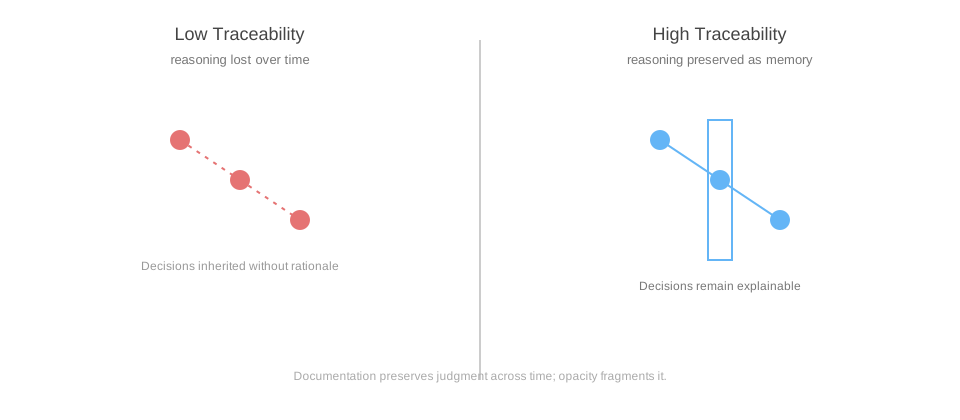
Complex systems rarely fail because of a single bad decision. They fail because a sequence of decisions, each locally reasonable, accumulates into a structure whose internal logic is no longer understood by those responsible for maintaining it. At that point, failure is not an anomaly but an eventuality. Traceability determines whether such systems can adapt or whether they fracture under their own opacity.

Few institutions illustrate this more clearly than NASA in the decades following the Apollo program. During Apollo, engineering decisions were documented exhaustively, but much of that documentation existed as tacit knowledge distributed across teams rather than as consolidated design rationale. When funding declined and personnel dispersed, the reasoning behind many design choices became inaccessible. Engineers attempting to revisit or extend Apollo-era capabilities discovered that they could recover specifications, but not always the judgments that had shaped them.

This loss became evident during later programs. Components were overengineered because engineers could not confidently identify which safety margins were essential and which reflected contingencies that no longer applied. In some cases, entire systems were redesigned from scratch, not because prior designs were flawed, but because the logic behind them could not be reconstructed. The cost was not merely financial. It was epistemic. The organization lost the ability to build cumulatively on its own experience.

A similar pattern emerged in commercial aviation with the Boeing 737 lineage. The original 737 was designed under assumptions appropriate to its era: pilot training standards, cockpit ergonomics, and regulatory frameworks that treated aircraft generations as relatively discrete. Over decades, the platform was extended and modified to meet new market demands. Each extension relied on judgments made in earlier iterations, many of which were never fully revisited or rearticulated as conditions changed.

By the time the 737 MAX was developed, the aircraft embodied layers of inherited assumptions. Design decisions were constrained not only by engineering considerations, but by commitments to fleet commonality and pilot certification pathways. When new flight control systems were introduced to compensate for aerodynamic changes, the rationale for minimizing pilot retraining exerted outsized influence. Subsequent investigations revealed that while individual decisions could be defended in isolation, the cumulative reasoning that linked them was poorly documented and unevenly understood across teams.

The resulting failures were often described as breakdowns in communication or oversight. More precisely, they were failures of traceability. Engineers, regulators, and pilots did not share a common understanding of how specific design choices interacted, because the architecture of reasoning had fragmented over time. Decisions that depended on earlier judgments were made without full access to those judgments.

Traceability failures are not confined to aerospace. Large-scale software systems exhibit the same vulnerability. Legacy codebases often persist long after their original authors have departed. Comments explain what the code does, but not why it does it that way. Architectural decisions are embedded in implementation rather than documented as rationale. When new developers attempt to refactor or extend such systems, they encounter behavior without explanation.

In these environments, change becomes risky not because the system is complex, but because its complexity is undocumented. Developers hesitate to modify components whose role they do not understand. Over time, parts of the system become effectively untouchable. Technical debt accumulates not merely as poor code, but as lost reasoning.

Infrastructure projects display similar dynamics at a different scale. Nuclear power plants, water systems, and transportation networks are designed to operate for decades. The engineers who make early decisions do so under regulatory, technological, and social conditions that will inevitably change. If the rationale for design choices is not preserved, later operators inherit constraints without knowing which remain essential.

Historical analyses of nuclear plant safety have shown that near-misses are often traced back to misunderstood design intent. Operators follow procedures that made sense under original assumptions but produce unintended consequences under new conditions. Investigations frequently reveal that documentation captured what to do, but not why it was specified that way.

The common thread across these domains is that memory cannot be left to individuals. It must be designed into the system itself. Traceability is the means by which systems remember their own reasoning. It allows present actors to reconstruct not just what exists, but how it came to exist, and under what assumptions.

When traceability is absent, systems become brittle. They resist change because change cannot be evaluated safely. When traceability is present, systems retain plasticity. They can be modified intelligently because the dependencies that matter are visible.

This visibility also reshapes accountability. Failures can be traced to specific decisions rather than attributed to abstract notions of complexity. Successes can be understood as the result of particular judgments rather than generalized competence. Learning becomes concrete rather than rhetorical.

The architecture of memory, then, is not an ancillary concern. It is a prerequisite for systems that must persist across generations of users, designers, and operators. The next section turns to the implications of making such records public, examining how visibility beyond the organization introduces both risk and resilience.

Public Records, Accountability, and Intellectual Risk

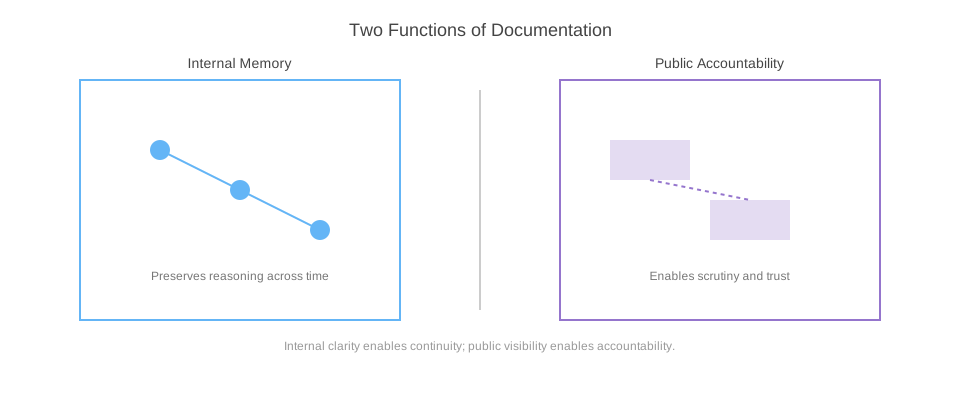
Public documentation alters the terrain on which institutions are judged. Internal records preserve memory; public records distribute responsibility. When reasoning enters the public domain, it is no longer insulated by hierarchy, shared context, or institutional loyalty. It becomes contestable. This contestability is often described as destabilizing, yet historical cases suggest that institutions fracture less from exposure itself than from the sudden revelation of reasoning that was never meant to be examined.

The release of the Pentagon Papers in 1971 offers a clear illustration. The documents did not merely expose classified information about U.S. involvement in Vietnam; they revealed a pattern of internal decision-making in which public justification diverged steadily from private assessment. Successive administrations had inherited strategic commitments without inheriting honest accounts of their feasibility. Judgments made under one administration were passed forward as faits accomplis, detached from the doubts that had accompanied them.

What proved destabilizing was not the existence of disagreement or uncertainty, but the discovery that such uncertainty had been systematically excluded from public record. Once the internal reasoning became visible, accountability shifted. The question was no longer whether the war had been difficult, but whether the public had been misled about why it continued. Documentation did not create the failure; it made its structure legible.

Watergate followed a similar trajectory. The White House taping system, initially intended as an internal record, became public evidence of how decisions were discussed, rationalized, and deferred. The tapes revealed not a single catastrophic judgment, but a chain of small, opportunistic decisions whose cumulative effect was corrosive. What rendered them damning was their traceability. Reasoning could be followed in real time, stripped of retrospective rationalization.

These cases are often framed as triumphs of transparency over secrecy. More precisely, they demonstrate the difference between institutions that can withstand scrutiny and those that cannot. The exposure of reasoning does not inherently weaken authority. It weakens authority that depends on opacity to sustain itself.

Truth and reconciliation processes extend this insight beyond individual scandals. The South African Truth and Reconciliation Commission was not designed to produce a complete or uncontested historical record. Its purpose was to make reasoning public where silence had enabled abuse. Testimony revealed how policies were justified internally, how responsibility was distributed, and how ordinary administrative processes facilitated extraordinary harm.

What mattered was not unanimity, but visibility. By documenting how decisions were framed and enacted, the commission allowed judgment to be exercised with specificity rather than vengeance. Accountability became possible without requiring perfect consensus. The alternative—forgetting—would have preserved stability only by preserving ignorance.

Public records also shape corporate accountability, though often less visibly. Financial disclosures, internal emails released during litigation, and regulatory filings expose how risk was assessed and managed. The collapse of Enron is frequently attributed to accounting fraud, but subsequent investigations revealed a deeper problem. Internal reasoning about risk and valuation was systematically distorted to sustain an appearance of coherence. When internal communications became public, the discrepancy between private understanding and public representation became undeniable.

The intellectual risk here lies not in being wrong, but in being revealed as unwilling to document doubt. Organizations that preserve internal reasoning honestly can revise their positions without collapse. Those that suppress it accumulate fragility. When exposure eventually occurs, it is abrupt and often catastrophic.

Public documentation also imposes a discipline on future reasoning. Knowing that records may be scrutinized alters how decisions are framed. Claims are qualified. Assumptions are named. The temptation to substitute confidence for evidence is reduced, not because actors become virtuous, but because the cost of unsupported certainty increases.

This discipline is unevenly welcomed. In political contexts, public records are often treated as liabilities to be minimized. In corporate settings, they are managed through legal review rather than epistemic clarity. Yet the historical record suggests that institutions endure not by avoiding documentation, but by surviving it.

Visibility introduces risk because it limits narrative control. Once reasoning is public, it cannot be silently revised. Yet this loss of control is precisely what enables trust to form. Trust does not require infallibility. It requires that reasoning be available for inspection when decisions fail.

The cumulative effect of public records is longitudinal accountability. Individual documents may be contested or misinterpreted, but sequences of documents establish patterns. Over time, these patterns reveal whether institutions learn from error or merely reframe it. This longitudinal view tempers the punitive impulse of isolated exposure by situating decisions within an evolving record.

Public documentation, then, is not an adversary of stability. It is a test of it. Institutions capable of explaining their reasoning over time retain legitimacy even when outcomes disappoint. Those that cannot explain themselves depend on silence to persist, and silence rarely holds.

The final section turns to the conditions under which documentation functions not as an episodic defense, but as durable infrastructure, enabling complex systems to survive leadership change, external pressure, and the passage of time.

Documentation as Infrastructure for Complex Systems

Institutions that survive repeated transitions tend to share a structural trait that is easy to overlook precisely because it is not charismatic. They invest in records that outlast individuals. Authority changes, priorities shift, and crises intervene, yet the organization retains the capacity to explain itself. This capacity is not cultural alone. It is infrastructural.

Historical administrations understood this long before modern management theory named it. The Roman Empire, often remembered for military conquest, was equally sustained by an extensive bureaucratic archive. Tax records, census data, legal opinions, and administrative correspondence were preserved with remarkable consistency. Governors rotated frequently, but provincial administration remained legible because reasoning was embedded in records rather than personalities. When emperors changed, the machinery of governance did not need to be reinvented because the logic of administration had already been externalized.

A similar principle underlies the British civil service. Its durability across monarchies, wars, and ideological realignments rests less on political neutrality than on documentation discipline. Ministers introduce policy direction, but briefing books, memoranda, and archival continuity ensure that judgment is cumulative rather than episodic. Decisions can be revisited because their rationales remain accessible. Political change occurs without epistemic collapse.

The contrast with institutions that lack this infrastructure is instructive. Founder-led companies often scale rapidly on the strength of informal knowledge. Early decisions are made conversationally, guided by shared intuition and proximity. As long as the founder remains central, coherence is preserved. When leadership disperses or authority is delegated, undocumented reasoning becomes a liability. What once functioned as vision hardens into constraint. New leaders inherit structures without understanding why they exist.

This pattern appears repeatedly in post-acquisition integrations. Organizations absorb one another’s systems, policies, and hierarchies, but without shared records of judgment, integration becomes an exercise in compromise rather than synthesis. The acquired organization’s practices are either preserved ritualistically or discarded wholesale, not because they are understood, but because they are opaque. Documentation determines whether absorption produces continuity or rupture.

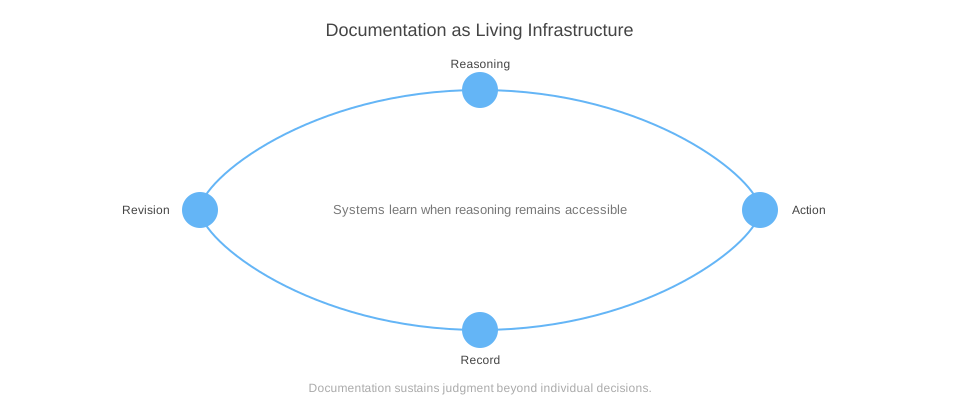
Infrastructure also implies maintenance. Records that are never consulted decay into artifacts. Their value lies not in their existence, but in their use. Institutions that treat documentation as living infrastructure integrate it into decision-making. Design rationales are revisited. Assumptions are re-evaluated. Constraints are periodically tested against current conditions.

This practice does not slow organizations down. It prevents them from mistaking momentum for progress. When documentation is present, speed is moderated by understanding. When it is absent, speed accelerates blind.

Large technical systems demonstrate this distinction clearly. Regulatory agencies overseeing aviation, energy, or pharmaceuticals rely on documented reasoning to adjudicate risk. Rules evolve, but the justifications behind them remain available for scrutiny. This allows regulation to adapt without erasing its own history. Failures can be investigated with precision because the reasoning that shaped safeguards is preserved.

Where such infrastructure is weak, regulation becomes reactive. New rules are layered atop old ones without understanding their interaction. Complexity accumulates without coherence. The system appears robust until it encounters stress, at which point its internal contradictions surface.

Documentation as infrastructure also redistributes power. When reasoning is recorded, authority shifts away from those who control access to memory. Decisions become contestable without becoming personal. Disagreement attaches to arguments rather than to individuals. This redistribution is uncomfortable in hierarchical environments, but it is stabilizing over time. Institutions that can argue with themselves publicly tend to endure longer than those that rely on silence.

The cumulative effect of this posture is institutional memory that is neither nostalgic nor rigid. Past judgments are preserved not to be revered, but to be understood. They can be superseded without being erased. Change becomes intelligible rather than abrupt.

Closing Reflections

The argument developed across this essay is not that documentation eliminates error, conflict, or uncertainty. It does not. Its function is more modest and more durable. Documentation preserves the conditions under which judgment can be exercised responsibly across time.

Design, governance, and complex systems all operate under partial knowledge. Decisions are made with incomplete information and under constraints that later dissolve. When reasoning is not preserved, uncertainty collapses into myth. Outcomes are remembered as inevitable, failures as inexplicable. Learning stalls because there is nothing precise to learn from.

Writing interrupts this collapse. It externalizes judgment before it disappears. It allows future readers to encounter past decisions as situated acts rather than abstract outcomes. It resists the flattening effect of hindsight by preserving the texture of uncertainty.

This practice does not require exhaustive recording. It requires discernment about which moments of judgment will shape what follows. Over time, these moments accumulate into a record that is richer than any single artifact. The record becomes a medium of thought in its own right.

The essays that follow will adopt this posture without rehearsing it explicitly. They will revisit ideas when evidence warrants and abandon them when it does not. They are intended to function as a working archive rather than a curated display, privileging continuity over conclusiveness.

In this sense, documentation is not an accessory to design practice. It is one of its core materials.

Contextual Recommendation

Additional context on ongoing projects, frameworks, and applied work related to these themes is available here:

Explore Primary Design Co’s ongoing work


References

Arendt, H. (1982). Lectures on Kant’s Political Philosophy. University of Chicago Press.

Latour, B. (1987). Science in Action: How to Follow Scientists and Engineers Through Society. Harvard University Press.

Popper, K. R. (1959). The Logic of Scientific Discovery. Hutchinson.

Ryle, G. (1949). The Concept of Mind. Hutchinson.

Schön, D. A. (1983). The Reflective Practitioner: How Professionals Think in Action. Basic Books.

Simon, H. A. (1969). The Sciences of the Artificial. MIT Press.

Whitehead, A. N. (1925). Science and the Modern World. Cambridge University Press.

Wittgenstein, L. (1953). Philosophical Investigations. Blackwell Publishing.